
The Field Problem
MedTech companies do not lack knowledge. They lack a reliable way to turn scattered knowledge into the current approved answer in the moment of need.
A field rep preparing for a hospital call has access to everything — in theory. The instructions for use are somewhere in the document management system. The latest service bulletin came through email last quarter. The clinical evidence summary lives in a SharePoint folder three levels deep. Training materials are in the LMS. The competitive comparison deck is in the DAM. The correct reimbursement codes are in a spreadsheet someone maintains manually.
In practice, the field has ten minutes before the meeting. Research from SoloFire and Nuvue puts the search burden at 43 hours per month per rep — time spent hunting across disconnected systems for information that should be instantly available. Salesforce’s State of Sales data confirms that reps spend only 28–30% of their week actually selling. One LinkedIn analysis of MedTech specifically found reps wasting 70% of their week on admin tasks — manual data matching, chasing internal teams, digging through scattered emails and documents.
They can’t reconcile six sources, verify which version is current, or synthesize a reliable answer across all of them. So they call a colleague, guess, or say they’ll follow up.
That’s not a training problem. That’s not a content problem. That’s a knowledge execution problem — and it has a measurable price tag.
The Cost of Scattered Knowledge
Quantifying the economic impact of knowledge fragmentation reveals a number that should focus attention: a mid-size MedTech company with 500 field representatives loses an estimated $18.7M–$31.2M annually — before accounting for full compliance and legal exposure. Full attribution across all loss categories reaches $67.5M.
The losses fall into five categories:
At 43 hours/month per rep and a fully loaded cost of $180K/year, search time alone represents $44,655 per rep annually. Across 500 reps, with 60% conservatively attributed to knowledge fragmentation: $13.4M/year in direct labor cost, producing no output.
When reps can't find or trust the answer, they escalate. At 4 escalations per rep per week, 45 minutes per escalation (rep + SME time combined), across 500 reps: 72,000 hours of SME and rep time consumed annually — at a blended cost of $5.76M.
Knowledge friction stalls deals. At $1.2M revenue per rep and a conservative 4% pipeline impact from slow or incorrect knowledge access, the revenue drag across 500 reps is **$6M/year** — attributable directly to the inability to answer questions quickly and accurately in the field.
Industry benchmarks show **80% of marketing content goes unused** by sales teams. For a MedTech company investing $8M annually in regulated content creation, approval, and review, that's $6.4M in sunk cost — with $1.9M recoverable through improved access and discoverability alone.
Wrong-version content in the field creates real exposure: regulatory audit remediation, compliance incidents, lost deals from outdated specs, and legal exposure from inconsistent field claims. One documented case: a MedDevice distributor **lost a $2M contract** because reps shared wrong device specs from outdated PDFs and Dropbox folders. Midpoint annual exposure: $3.6M.
The common root cause across all five categories is the same: no reliable mechanism to surface the current approved answer at the point of need.
The Hidden Gap in the Commercial Stack
The commercial stack in MedTech has grown sophisticated. CRMs track opportunity and relationship. Digital asset management systems house approved content. Learning management systems deliver training. Portals and shared repositories give field teams somewhere to look.
Each system does part of the job. None of them — individually or together — was designed to deliver a trusted, situational answer across all of them at once.
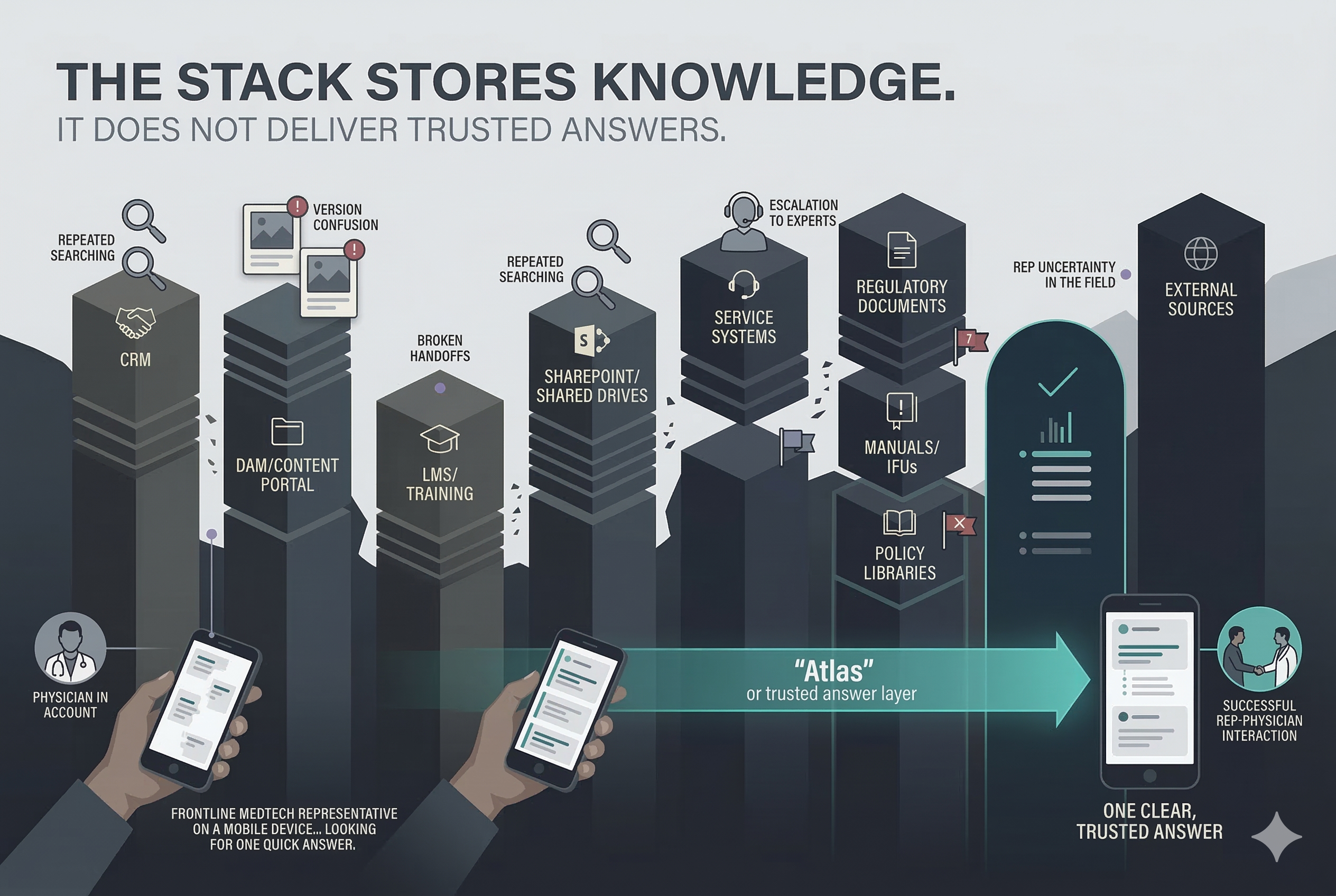
The result is a structural gap between what enterprises know and what they can reliably surface at the point of need. Field teams don’t need another portal. They don’t need a better search bar. They need the current approved answer — grounded in the right sources, aware of version and policy, traceable back to evidence — delivered in the moment of the interaction.
The problem is also growing. The European Commission’s June 2025 regulation expanding electronic instructions for use for professional-use medical devices increases the number of digital artifacts, publishing paths, and version control requirements. The bottleneck is no longer “can this be digital?” — it is “can the field get the right governed answer from the digital sprawl?”
Veridian doesn’t replace the commercial stack. It sits above it: connecting to sources already in place, organizing them semantically, and delivering field-ready answers from what’s already there.
Why Generic Search and Chatbots Are Not Enough
In consumer contexts, “helpful” is the bar. In regulated MedTech environments, helpful is not enough.
A field rep who gets a confident but incorrect answer about a device indication, a reimbursement pathway, or a contraindication faces real consequences — for the customer, the patient, and the company. FDA’s human factors guidance notes that labeling and training are not preferred safety controls specifically because they may be unavailable at the moment of use and training decays over time. An AI system that retrieves plausibly relevant content without knowing whether it’s current, approved, or applicable to the clinical context replicates this failure at scale, only accelerates non-compliance.
Semantically similar content retrieved from whichever sources were indexed. No version awareness. No policy constraints. No evidence citation. Confident-sounding output with no traceability.
Answers grounded in approved sources, aware of document version and source priority, constrained by policy and governance, traceable back to specific evidence — delivered with confidence indicators that tell the field when to escalate.
The difference is not model quality. It is architecture. Governed knowledge execution requires a semantic foundation, retrieval policies, provenance tracking, and governance constraints that generic AI chatbots do not have — and cannot be bolted on after the fact.
What ShakeIQ Veridian™ Does
Veridian is the frontline knowledge execution layer for regulated commercial and clinical interactions. It connects to the scattered internal and external sources the field already depends on, organizes them through a semantic fusion fabric, and uses governed agentic orchestration to retrieve, resolve, and synthesize answers — returning a field-ready response with evidence and confidence indicators.
Ingest IFUs, service manuals, clinical summaries, training content, SOPs, bulletins, and scientific literature from wherever they live — without requiring migration or system replacement.
The EnPraxis semantic fusion fabric structures ingested content into a governed, semantically coherent model — with version awareness, source priority, and provenance built in from the start.
Governed agentic orchestration plans the retrieval, resolves conflicts across sources, applies policy constraints, and synthesizes an answer — with multi-step reasoning and safe refusal logic when certainty is insufficient.
A field-ready answer with cited evidence, source attribution, confidence indicators, and a traceable decision path — so the field knows what to trust, what to verify, and when to escalate.
The field doesn’t see a system. They see a reliable answer — and they know where it came from.
The Value Recovery Case
Veridian is projected to recover 40–60% of the annual knowledge fragmentation loss within the first 12–18 months of deployment. For a 500-rep MedTech organization, that’s $12M–$16.6M in recoverable annual value against an investment of $750K–$1.5M.
8x–22x return in year one, with a payback period under 60 days based on search time and escalation savings alone.
40–60% reduction in rep time spent searching for information — recoverable from day one of deployment.
30–50% reduction in escalations to internal subject matter experts, freeing SME capacity for higher-value work.
The model scales predictably. For a 100-rep team, annual recoverable value is $2.4M–$3.3M on an investment of $150K–$300K. For a 2,000-rep organization, recoverable value reaches $47.8M–$66.4M. The ROI ratio holds at 8x–22x across all sizes because the loss categories scale with headcount and the platform economics do not.
Why This Works for Sales Ops
Veridian doesn’t require ripping out the commercial stack. It is not a CRM decision or a platform replacement. Sales Ops retains full control over approved content sources, access scope, rollout, usage visibility, and policy guardrails.
Reps get trusted answers in seconds. Pre-call preparation that previously required thirty minutes of hunting across systems shrinks to a single governed query.
Every rep draws from the same governed knowledge base. Messaging stays aligned across the field — regardless of tenure, territory, or how recently they completed training.
Marketing, Training, Service, Medical, and Sales Ops all benefit — Veridian increases actual downstream use of content those teams already invested in creating and approving.
Critically, the field problem is easy to demonstrate. The latest IFU, the reconciliation between marketing positioning and service guidance, a field-ready answer under time pressure — the value of Veridian is visible in the first use case. That’s what makes it a practical land: a focused pilot on one product family or knowledge domain delivers evidence in weeks, not quarters.
Why EnPraxis Makes Veridian Possible
Veridian works because it is built on EnPraxis — the platform that provides the semantic fusion fabric, governed agentic orchestration, and compliance-grade traceability that regulated knowledge execution requires. Generic AI infrastructure cannot deliver this. EnPraxis was designed for exactly this class of problem.
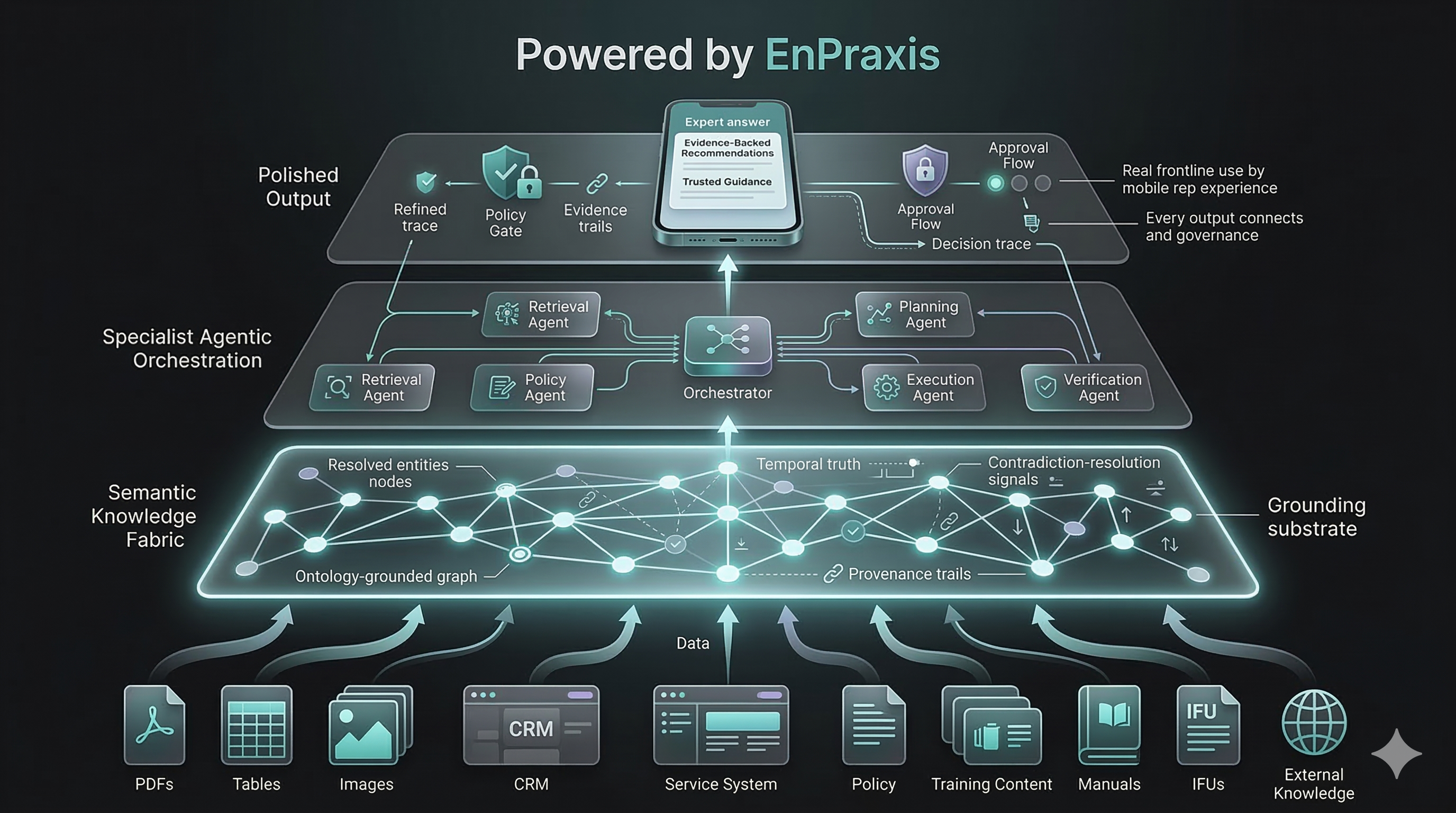
Model-driven, semantically organized, hybrid retrieval with provenance-first grounding. Lexical, vector, graph, and semantic stores unified into a single reasoning substrate — with full source attribution baked in, not bolted on.
Multi-agent planning, tool use, and workflow execution that turns retrieved knowledge into governed systems of action. Not just retrieval — orchestrated reasoning that knows when to retrieve, when to synthesize, and when to escalate.
Policies, constraints, provenance, and decision traces are first-class platform concepts — not compliance overlays. Every answer Veridian delivers carries a traceable path back to governed sources. Regulated industries get auditability by design.
Ingestion of PDFs, presentations, Excel, transcripts, SOPs, and scientific literature with domain-validated ontologies and provenance-backed reasoning. Veridian knows not just what was said — but where, in which version, and under what authority.
The Takeaway
ShakeIQ Veridian™ is a proof point. It demonstrates that the governed knowledge execution architecture EnPraxis enables is not theoretical — it is deployable, practical, and directly valuable to regulated commercial operations in MedTech today.
The numbers make the case: $18.7M–$31.2M in recoverable annual losses, a platform that recovers 40–60% of that within 12–18 months, and an ROI that turns in under 60 days. The problem is real, the cost is documented, and the recovery path is clear.
But the pattern Veridian represents extends beyond MedTech. The same structural problem — abundant content, fragmented sources, no reliable way to surface the current approved answer at the point of need — exists in every regulated industry. Life sciences field service. Financial advisory. Clinical operations. Defense procurement. Anywhere that fragmented enterprise knowledge needs to become trusted answers for the people who act on them.
The opportunity is not another content repository or another chatbot. It is a governed knowledge execution layer that turns fragmented enterprise truth into trusted answers — and, over time, into systems of action that can reason, decide, and act on that knowledge reliably and at scale.
Veridian is one proof point. EnPraxis is the platform that makes it possible.