Pharmaceutical companies have invested heavily in deviation management processes, CAPA programs, eQMS platforms, compliance frameworks, and investigation methodologies.
Yet despite these investments, organizations continue to struggle with repeat deviations, recurring CAPAs, repeated audit observations, knowledge loss, investigation inconsistency, dependence on individual experts, and institutional memory gaps.
The industry has become increasingly effective at managing quality events. It has become far less effective at systematically learning from them.
This article argues that the next evolution of Pharmaceutical Quality Systems (PQS) is not merely better deviation management, more sophisticated CAPA workflows, or additional automation. The next evolution is the creation of an organizational learning layer that transforms quality events into institutional knowledge, better decisions, and continuous improvement.
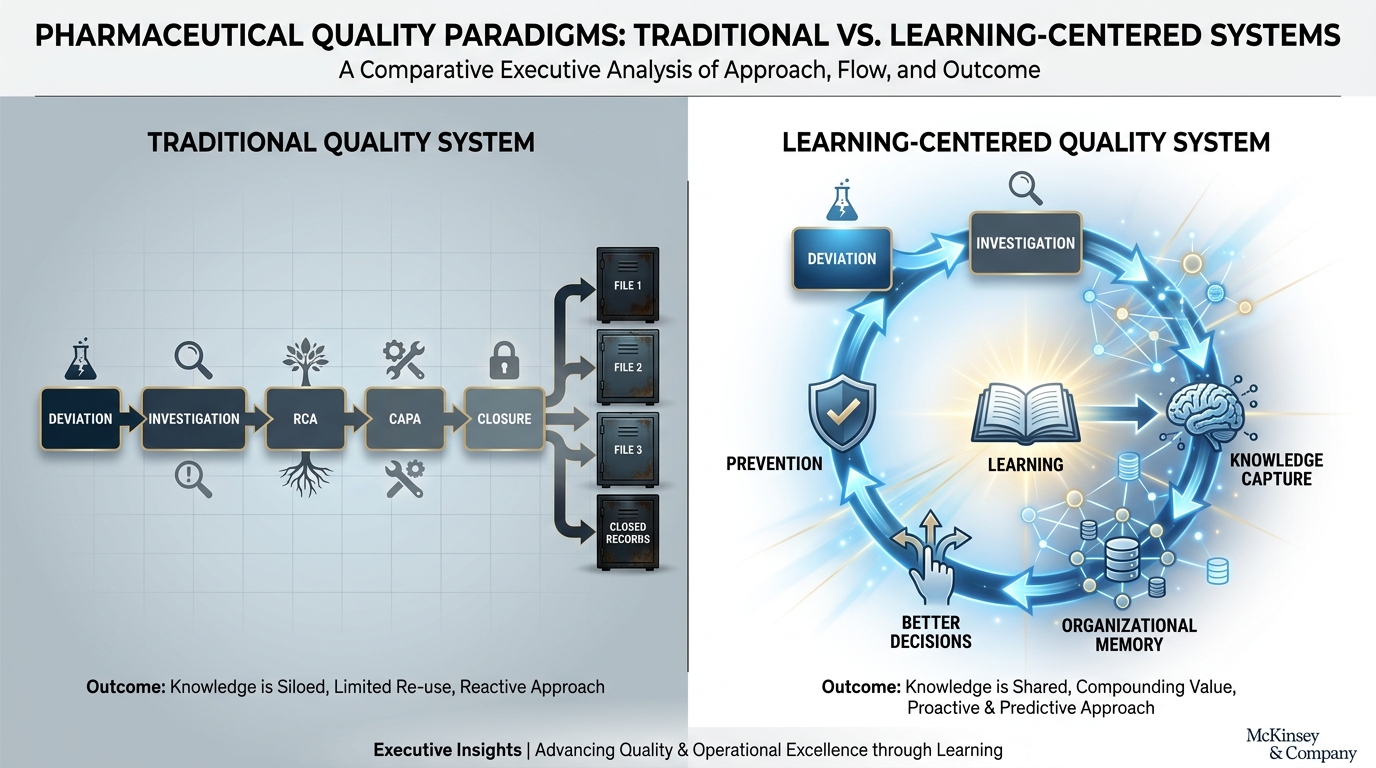
The Deviation Management Paradox
Every pharmaceutical organization understands the importance of deviation management. When a deviation occurs:
- The event is documented.
- An investigation is initiated.
- Root cause analysis is performed.
- Corrective and Preventive Actions (CAPA) are implemented.
- QA reviews and closes the record.
The deviation is compliant. The deviation is closed. The deviation is complete.
Or is it? The most important question often remains unanswered:
The deviation is closed. But did the organization actually learn anything?
Why Deviation Management Exists
Deviation management exists for a reason far greater than compliance. Its purpose is to protect patients, protect product quality, maintain data integrity, ensure regulatory compliance, strengthen processes, reduce future risk, and drive continuous improvement.
Regulations such as FDA 21 CFR 211.192, ICH Q9 (Quality Risk Management), ICH Q10 (Pharmaceutical Quality System), EU GMP Chapter 1, and PIC/S guidance all reinforce the same expectation: quality events should improve the effectiveness of the Quality System.
The objective is not documentation. The objective is understanding.
The Reality of Pharmaceutical Deviations
Modern pharmaceutical organizations generate enormous volumes of quality information across every function:
- Manufacturing events — process excursions, equipment failures, yield loss, environmental monitoring excursions, process parameter deviations.
- Laboratory events — Out of Specification (OOS), Out of Trend (OOT), analytical failures, stability failures.
- Validation events — qualification failures, protocol deviations, process validation issues.
- Supply chain events — supplier quality issues, incoming material failures, packaging defects.
- Data integrity events — documentation errors, missing records, electronic system failures, audit trail discrepancies.
Large organizations may accumulate thousands of quality events annually. The challenge is rarely a lack of information. The challenge is transforming information into knowledge.
Investigation Excellence Matters
Recent thought leadership in pharmaceutical quality has appropriately focused on investigation quality. A deviation investigation should never be a paperwork exercise.
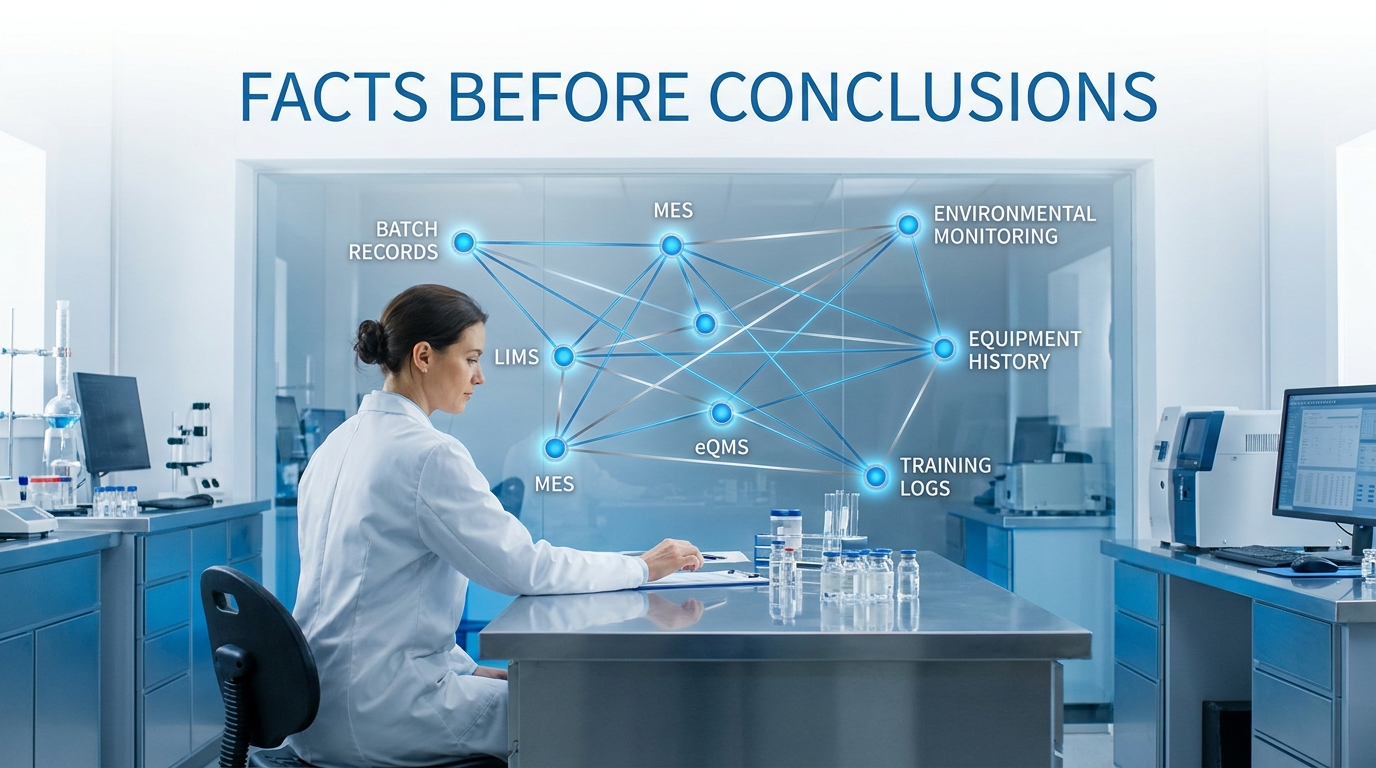
Excellent investigations require clear problem definition, evidence preservation, objective fact gathering, process observation (Gemba), appropriate RCA tool selection, scientific reasoning, verification of cause-and-effect relationships, impact assessment, traceability, and system thinking.
Strong investigators ask: What weakness in the system allowed this event to occur?
Weak investigations ask: Who made the mistake?
This distinction is critical.
Why Investigations Fail
Despite established methodologies, investigations frequently fail for predictable reasons.
Human error becomes the root cause. The investigation concludes “Operator Error” without asking why the procedure was misunderstood, why the process was vulnerable, why the error was not detected, or why the system permitted the failure. Human error is often a symptom — not the root cause.
Conclusions before evidence. Many investigations begin with a hypothesis and then search for supporting evidence. Excellent investigations collect evidence before developing conclusions.
Wrong RCA tool selection. Different problems require different approaches — 5 Why Analysis, Fishbone Analysis, Fault Tree Analysis, Barrier Analysis, Timeline Analysis. No single RCA method is appropriate for every investigation.
Failure to observe reality. Many investigations rely on documents. Too few investigators observe the actual process. Gemba remains one of the most underutilized investigation tools.
Root Cause Analysis Is Necessary But Not Sufficient
Root Cause Analysis is essential. But even a perfect RCA does not guarantee organizational improvement. Consider the following:
A deviation occurs. A world-class investigation is performed. Root cause is identified. CAPA is implemented. QA closes the record.
Six months later, a nearly identical deviation occurs elsewhere.
What happened? The investigation succeeded. The organization failed to learn.
The Organizational Learning Gap
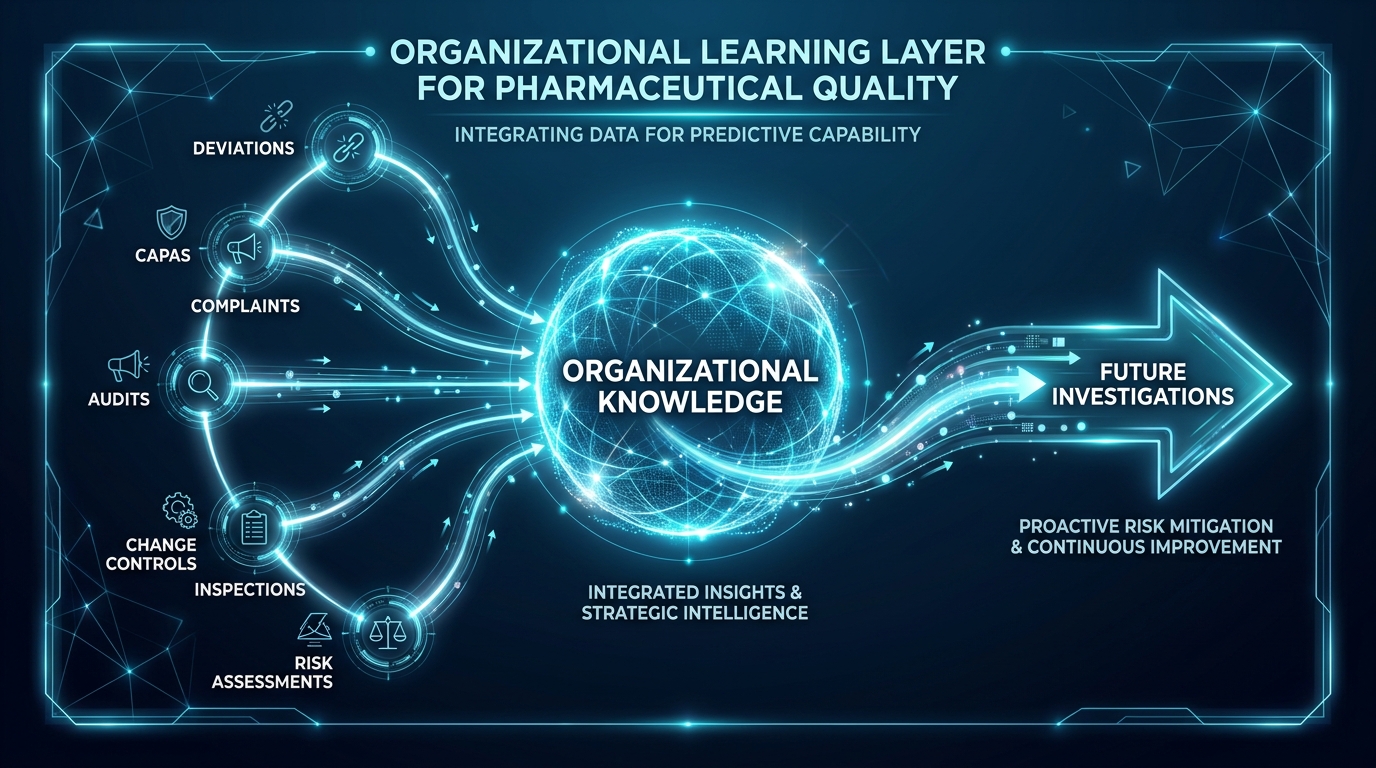
This is where many Pharmaceutical Quality Systems struggle. Every investigation creates knowledge — yet that knowledge often becomes trapped in investigation reports, CAPA records, audit reports, change controls, individual experts, and personal experience.
The critical question becomes: Once the investigation is complete and the root cause is identified, how does that learning become available to the next investigator facing a similar event?
For many organizations, the answer is: it doesn’t.
The Hidden Cost of Organizational Amnesia
Organizations often possess decades of accumulated experience — thousands of deviations, thousands of CAPAs, years of audits and inspections, historical process knowledge, and deep subject matter expertise.

Yet every new investigation frequently starts from scratch. Investigators ask: Have we seen this before? What CAPAs worked? What CAPAs failed? What patterns exist? What similar events occurred? What did we learn?
Finding those answers is often difficult — not because the knowledge does not exist, but because it is inaccessible.
Your organization already knows the answer. The challenge is finding it.
Quality Systems of Record vs Learning Systems
Traditional quality systems excel at managing records: deviations, CAPAs, change controls, complaints, audits, training, and documentation. These are Quality Systems of Record.
But organizations increasingly need something else: Quality Systems of Learning — systems that help answer what we know, what we have learned, what we should do next, what risks are emerging, and what patterns are developing.
Quality by Design, Risk Management, and Continuous Improvement
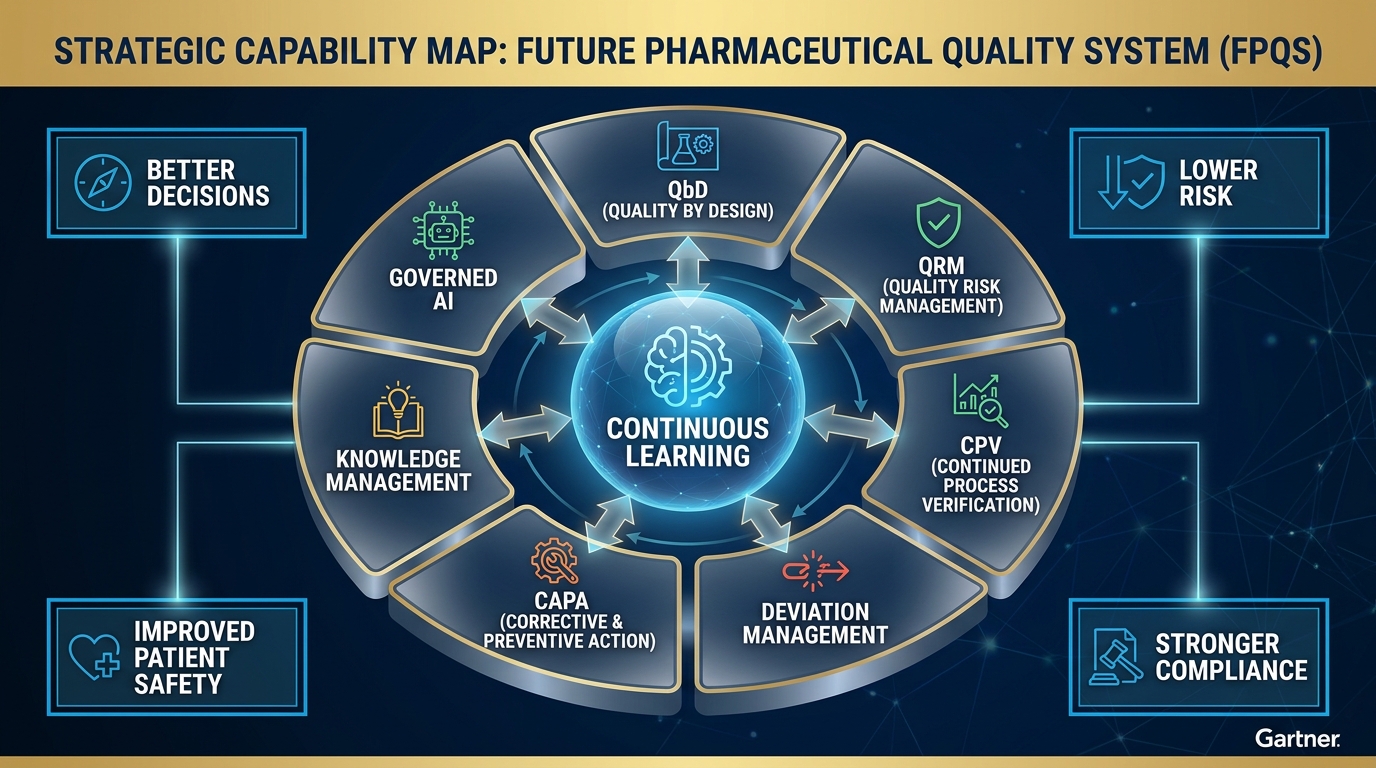
The concept of organizational learning is already embedded within modern pharmaceutical quality principles.
- Quality by Design (QbD) — learning improves process understanding; process understanding reduces variability; reduced variability improves quality.
- Quality Risk Management (QRM) — learning improves risk identification; risk identification improves prevention.
- Continued Process Verification (CPV) — learning improves process control; process control improves predictability.
- Pharmaceutical Quality Systems (ICH Q10) — learning improves the Quality System itself.
The ultimate purpose of every investigation is to strengthen the system.
The Emerging Role of AI
Artificial Intelligence should not replace investigators. It should help organizations learn faster. The greatest opportunity may not be automation — it may be augmentation.
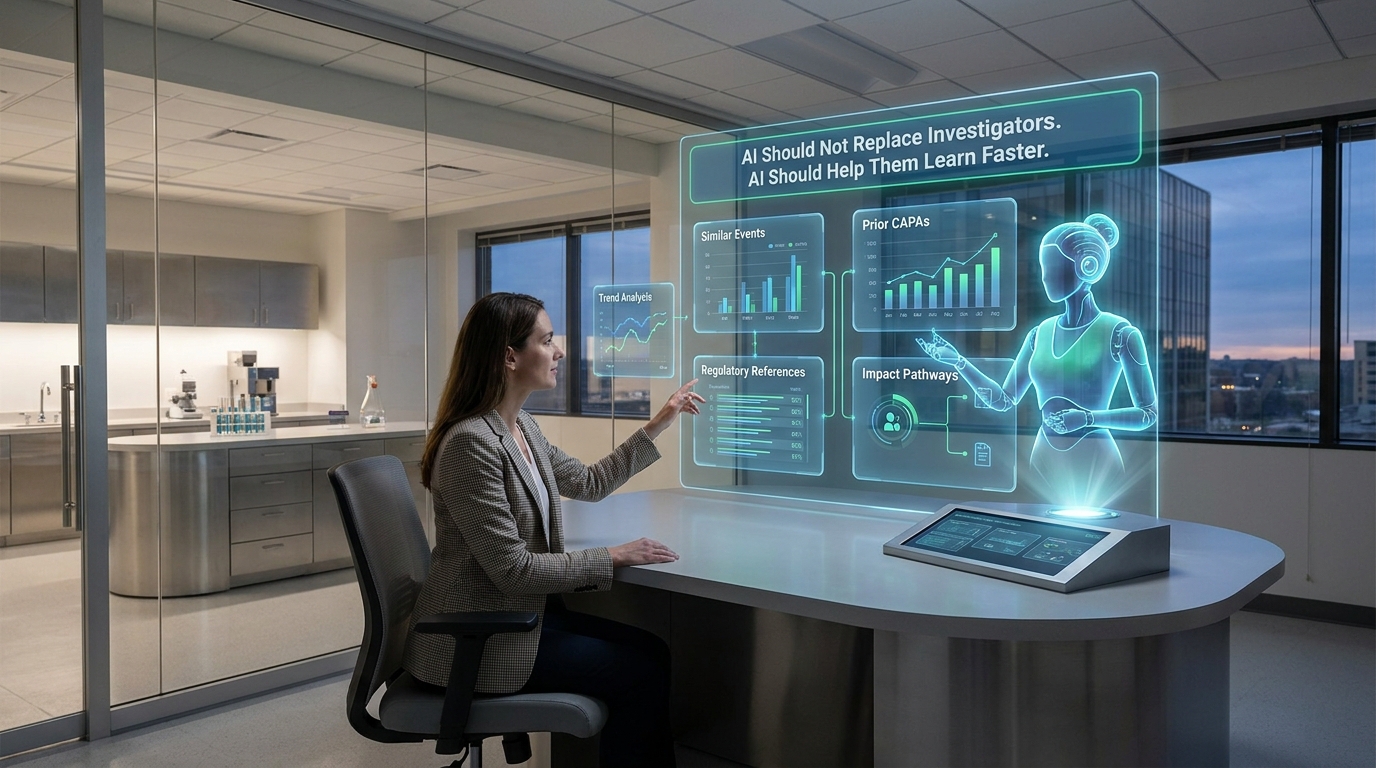
Examples include:
- Similar event discovery — finding prior investigations that resemble the current event.
- Organizational memory — making historical knowledge accessible.
- Regulatory intelligence — providing context from FDA, EMA, MHRA, PIC/S, and ICH.
- Trend analysis — detecting recurring signals before they become systemic failures.
- Investigation support — helping investigators identify relevant evidence, potential impact pathways, prior lessons learned, and related CAPAs.
AI should not make decisions. AI should help investigators benefit from everything the organization has already learned.
The Future of Deviation Management
Traditional view: Deviation → Investigation → RCA → CAPA → Closure.
Future view: Deviation → Investigation → Understanding → Learning → Knowledge Capture → Organizational Memory → Better Decisions → Prevention.
This shift represents a fundamental evolution in how organizations think about quality.
From Managing Events to Building Intelligence
The pharmaceutical industry has spent decades improving its ability to manage quality events. The next challenge is learning from them.
Organizations that excel in the future will not necessarily be those with the most deviations closed. They will be those that learn faster, retain knowledge longer, share lessons more effectively, improve decisions continuously, and reduce risk proactively.
Because the ultimate purpose of a Pharmaceutical Quality System is not simply to manage deviations. It is to continuously improve the organization’s ability to make quality decisions.
The EnPraxis Perspective
Every event is evidence. Every investigation is learning. Every lesson becomes organizational knowledge. Every future decision should benefit from that knowledge.
From managing quality events to learning from them.
See how EnPraxis builds a governed organizational learning layer on top of your existing quality system — turning deviations, CAPAs, and investigations into accessible institutional knowledge that strengthens every future decision.
The future of pharmaceutical quality may not be defined by how effectively we manage quality events. It may be defined by how effectively we learn from them.
EnPraxis AI — Semantic Intelligence for Regulated Enterprise Turning probabilistic AI into purposeful, auditable action.