
When a Form 483 or Warning Letter arrives, most organizations immediately increase activity. Consultants are engaged. Workstreams are launched. Status meetings multiply. Costs begin climbing. Yet one question often remains unanswered: what is actually happening inside the operation?
This is the hidden cost of remediation. It is not the consulting invoice or the headcount. It is the millions spent producing activity before anyone has built a defensible understanding of operational reality — the difference between knowing where records live and knowing how compliance is actually achieved.
The Escalation Ladder
Regulatory pressure rarely stays where it starts. Each unresolved signal raises the stakes — for product approvals, for the board, for revenue. Understanding the escalation ladder is the first step to getting ahead of it.
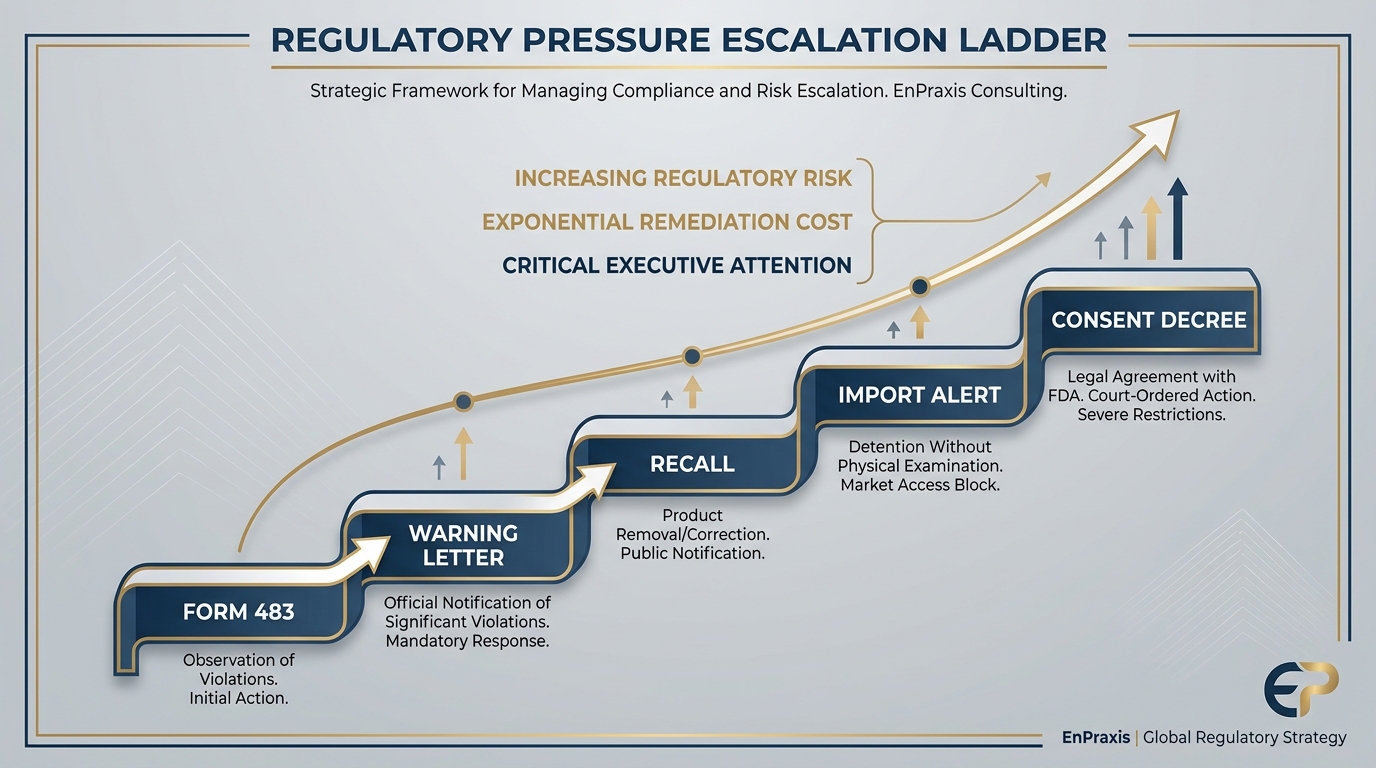
- Form 483 — inspectional observations and a hard clock on your response.
- Warning Letter — a public signal that draws board attention and puts new-product approvals at risk.
- Recall — product action, customer impact, and intensified scrutiny.
- Import Alert — blocked shipments and direct revenue impact.
- Consent Decree — court-supervised remediation, third-party oversight, and high sustained cost.
Each rung up the ladder multiplies risk, remediation cost, and executive attention. The organizations that recover fastest are the ones that break the climb early — by understanding the operation before the next inspection, not after the next escalation.
A 483 is not just an observation. It is a clock — and the cost of misreading it compounds at every stage of the ladder.
The Traditional Recovery Pattern
The default response to regulatory pressure is to add capacity. More consultants. More interviews. More workshops. More spreadsheets. More PMOs. More status meetings. Each addition feels like progress. Together, they form a machine that consumes budget while conflicting priorities multiply.
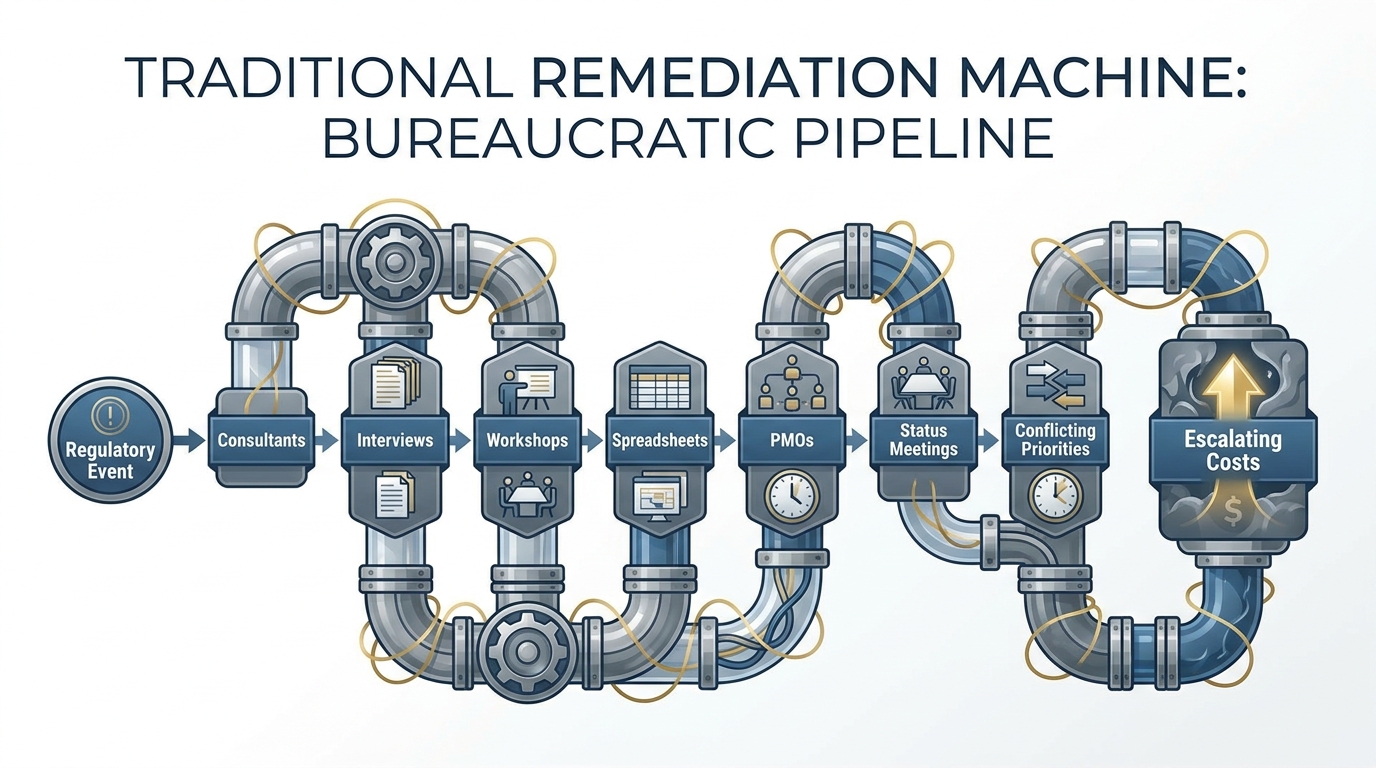
The pattern fails in predictable ways:
- Discovery is manual and slow — weeks of interviews and synthesis pass before experts reach the decisions that matter.
- Effort rarely compounds. Findings live in decks and trackers, and the next workstream re-discovers what the last one already learned.
- Leadership sees filtered status, not the operational reality underneath it.
- Spend outruns risk reduction. Consultants, discovery, reporting, PMOs, and meetings consume the budget; actual improvement is the smallest line item.
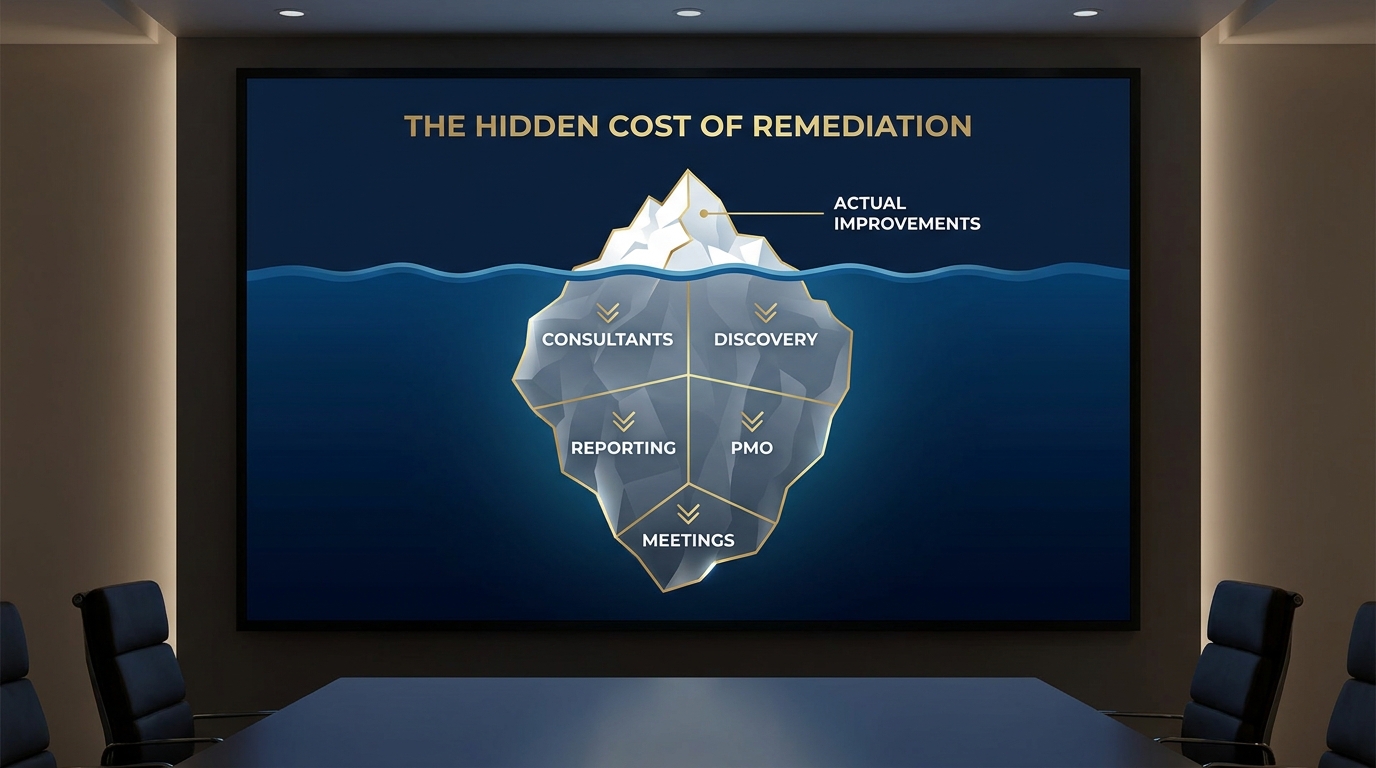
None of this is a failure of effort. It is a failure of sequencing: activity is funded before understanding is built.
Why Understanding Is So Difficult
The hardest part of recovery is not closing observations. It is answering a deceptively simple question: how is this work actually done?
Written procedures describe how the operation is supposed to run. Actual operations reflect how it really runs — shaped by exceptions, workarounds, tribal knowledge, and the realities of the floor. The gap between the two is where findings, recurrence, and regulatory risk live.
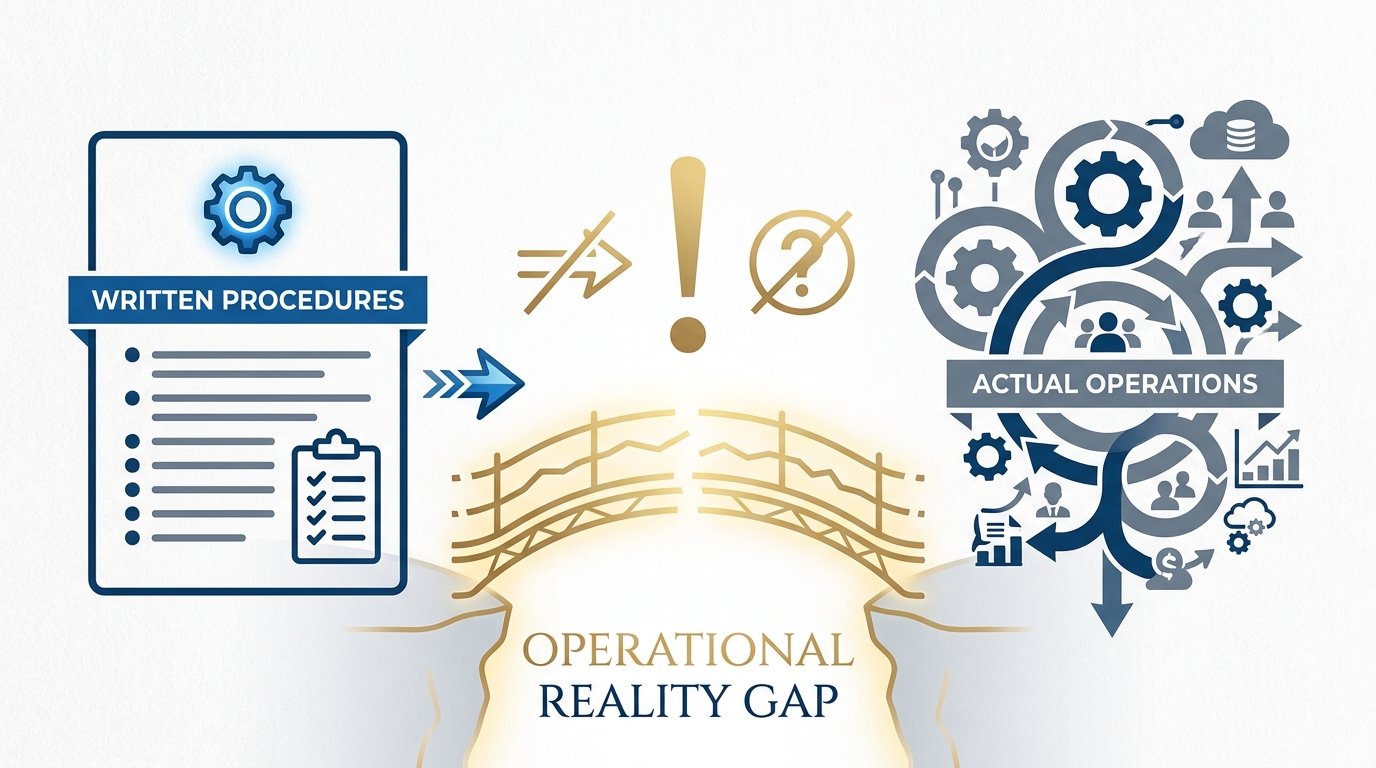
That gap is difficult to see because the evidence is scattered across QMS, CAPA, complaints, deviations, supplier quality, manufacturing records, and the working knowledge of the people who do the job. Manual discovery can eventually surface it — but slowly, inconsistently, and at enormous cost. By the time a traditional effort has reconstructed the picture, the clock has already advanced.
Cognitive Recovery Advisory
There is a better order of operations. Lead with understanding; earn the activity. That is the premise of Cognitive Recovery Advisory™.
Instead of deploying an army to gather information, a small team of experts is supported by agent-assisted discovery grounded in your standards, processes, people, evidence, and operational data. The advisory work stays human; the discovery is compressed.
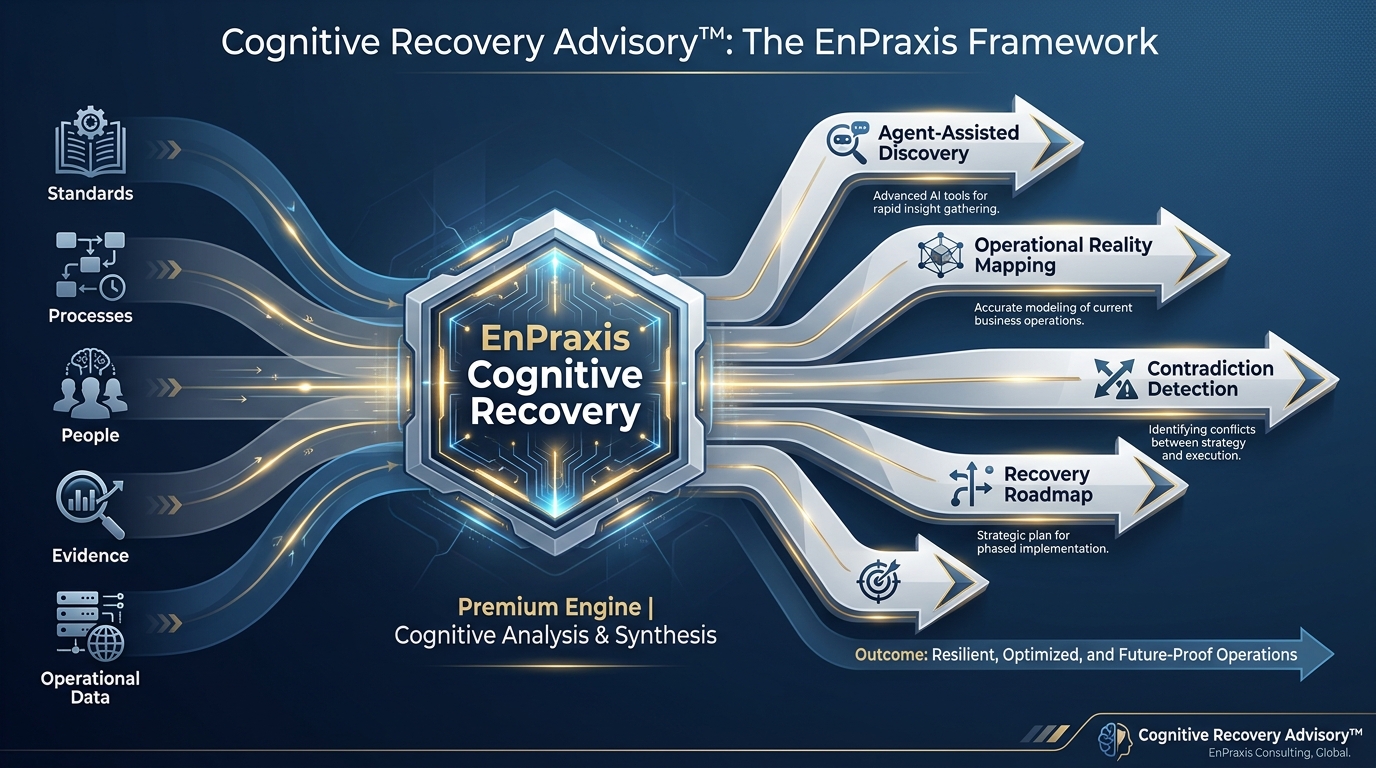
The motion moves in one direction:
- Agent-assisted discovery conducts structured, evidence-grounded interviews at scale, with experts in the loop.
- Operational reality mapping captures how compliance is actually achieved — not how procedures say it should be.
- Contradiction detection surfaces where written procedure and actual practice diverge.
- A recovery roadmap turns that understanding into a prioritized plan grounded in evidence and judgment.
- Focused recovery actions concentrate effort on the smallest set of actions that materially reduce current pressure.
The result is not another 200-page assessment to defend. It is a clear picture of operational reality and the few actions that matter most — produced in weeks, not quarters.
The Five Questions Every Recovery Team Must Answer
Before spending the next dollar on remediation activity, a recovery team should be able to answer five questions with evidence:
- What is actually happening today? How is compliance really achieved across the operation — not how the SOP describes it?
- Where does reality diverge from procedure? Which contradictions between documented practice and actual practice are driving findings and risk?
- What are the true root causes? Which observations are symptoms of the same underlying failure mode, and where else could it exist?
- What are the few actions that matter most? What is the smallest set of actions that satisfies current concerns, reduces recurrence, and improves inspection readiness?
- Can we defend how we got here? Does every conclusion trace to evidence, with human review where judgment matters?
If a recovery program cannot answer these, more activity will not help. It will simply produce more closed records without a clearer picture of operational reality.
From Understanding to Recovery
Understanding is not the destination — it is the foundation. Once operational reality is clear, recovery follows a confident path: from the pressure event, to understanding, to a roadmap, to execution, to assurance.
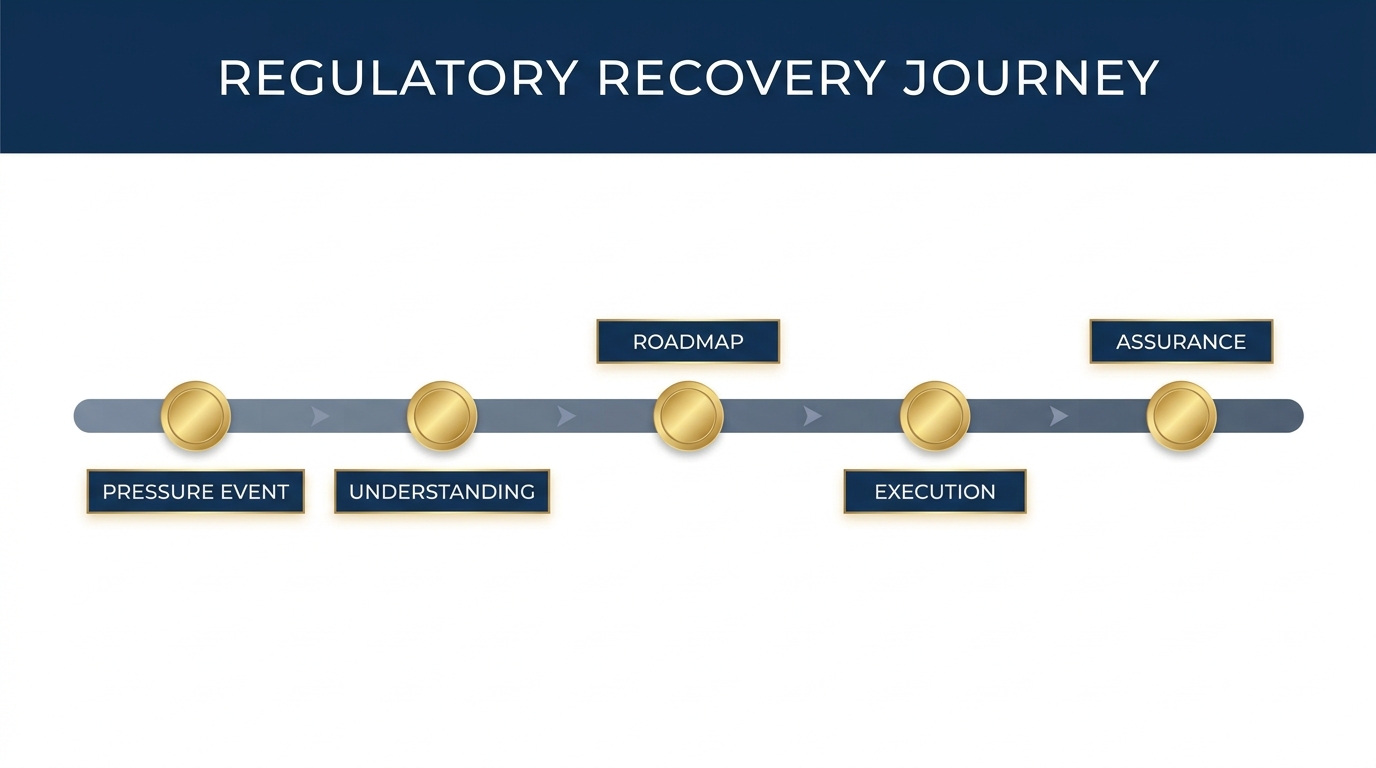
This is also where the economics change. The traditional pattern needs twenty consultants over eight weeks before experts reach the decisions that matter. Cognitive Recovery Advisory™ compresses that discovery — three to five experts supported by agent-assisted discovery — so judgment, not data collection, drives the work.
That compression is not about replacing experts, consultants, or your QMS. It is about removing the manual discovery burden that sits between regulatory pressure and the decisions that resolve it.
From regulatory pressure to confident recovery.
See how Cognitive Recovery Advisory uses agent-assisted discovery to quickly understand operational reality and deliver a focused recovery roadmap — the smallest set of actions that matter most under regulatory pressure.
When regulatory pressure arrives, clarity matters more than activity. The organizations that recover fastest do not start by spending. They start by understanding what is actually happening — and then concentrate their effort, and their budget, on the few actions that matter most.
EnPraxis AI — Semantic Intelligence for Regulated Enterprise Turning probabilistic AI into purposeful, auditable action.