
Every enterprise AI initiative begins with the same optimism. The proof of concept works. The model is sharp. The retrieval is fast. Leadership is aligned.
Then you try to scale it.
More data sources. More business units. More edge cases. More questions the AI can’t confidently answer — not because the information doesn’t exist, but because nobody has made explicit what the information means in this specific organization, in this specific context, for this specific decision.
This is the scaling problem that almost nobody is talking about. And it isn’t a model problem. It isn’t a retrieval problem. It’s a meaning problem.
This piece was inspired by a recent post from Darlene Newman, AI Strategy, Execution & Scale Advisor, who named this gap with unusual precision. Her observation — that teams discover the meaning problem from the bottom up, only after pilots fail to scale, and that leadership hasn’t yet declared meaning as infrastructure — is exactly what we see. We wanted to extend that thinking with the operational lens we apply at EnPraxis.
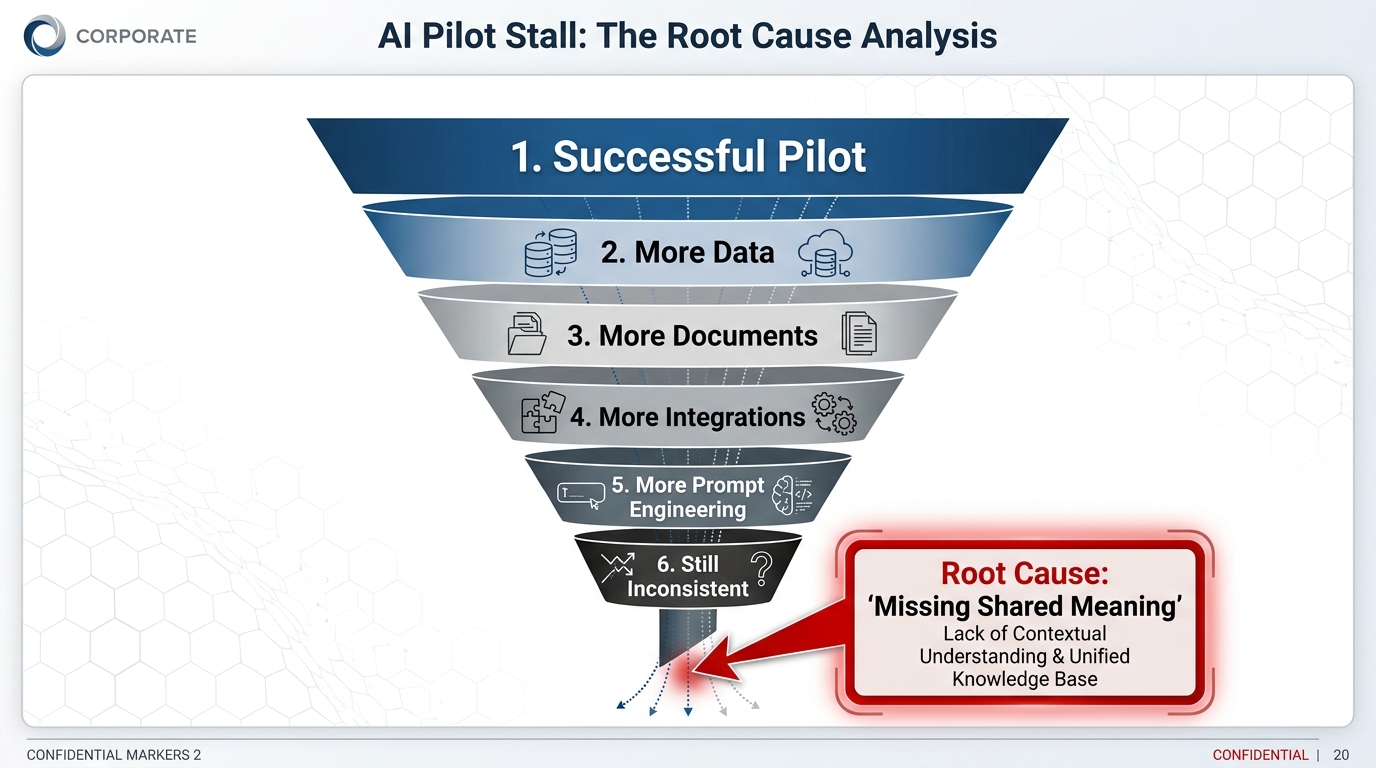
The Enterprise AI Scaling Problem
The journey is familiar to anyone who has moved past the pilot phase.
It starts well. You identify a high-value use case. You connect a model to a curated set of documents. The demo is impressive. Stakeholders see the potential. You get a green light to expand.
So you expand. More documents. More systems. More users from different functions with different contexts and different expectations.
And that’s when the model starts hedging. Outputs become inconsistent. The same question returns different answers depending on which documents surfaced. A response that is technically accurate in one business unit is wrong in another — not because the facts changed, but because the meaning of those facts changes depending on who is asking and why.
You implement RAG. You refine your prompts. You tune retrieval parameters. You invest in better chunking and embeddings.
The model gets better at finding relevant information. But the fundamental problem — that the information retrieved doesn’t carry shared operational meaning — remains unsolved.
The issue is rarely information access. The issue is shared meaning.
The Great Retrieval Misdiagnosis
The enterprise AI field has largely converged on retrieval as the solution to AI scaling. Need the model to know more? Add more documents. Need it to stay current? Connect it to live data. Need it to understand your business? Improve your retrieval pipeline.
This is a reasonable instinct. But it misidentifies the problem.
Retrieval answers one question: What information exists?
That is a necessary question. But it is not the question that drives decisions. The question that drives decisions is a different one entirely: What does this information mean in this business?
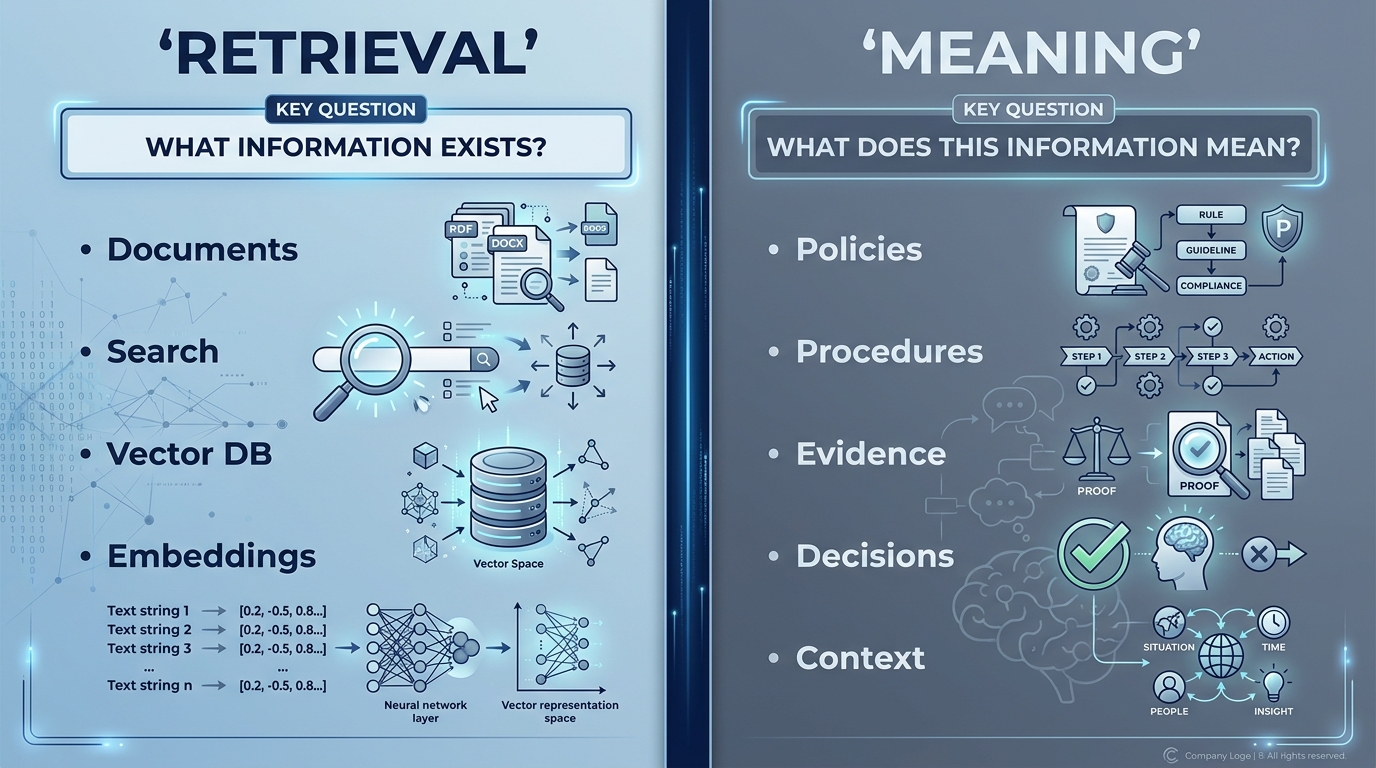
Consider a quality organization working through a product complaint. The complaint record exists in the system. The relevant SOP exists. The CAPA history exists. The audit findings exist.
Retrieval finds all of it. But it cannot answer: Is this complaint a signal of a systemic issue or an isolated deviation? Does the SOP governing this situation take precedence over the regional guidance? Who is authorized to make the determination? What constitutes sufficient evidence to close this investigation?
Those answers live in organizational understanding — in the shared, operational meaning that experienced people carry and apply every day. Retrieval doesn’t surface that meaning. It surfaces information. Meaning is something else entirely.
AI Doesn’t Create Ambiguity. It Reveals It.
Here is the uncomfortable truth that AI is forcing organizations to confront: the ambiguity was always there.
Humans compensate for ambiguity constantly — through relationships, tribal knowledge, informal escalation paths, and institutional memory that accumulates over years. A senior quality engineer knows which engineer to call when a deviation falls into a gray area. A regulatory affairs lead knows that “compliant” means something different to one regional office than another. A data analyst knows which numbers to trust and which to ignore.
This informal infrastructure is enormously valuable. It is also invisible, unscalable, and unreliable. When people leave, it walks out with them. When organizations grow, it breaks down. When decisions need to be audited, it can’t be produced.
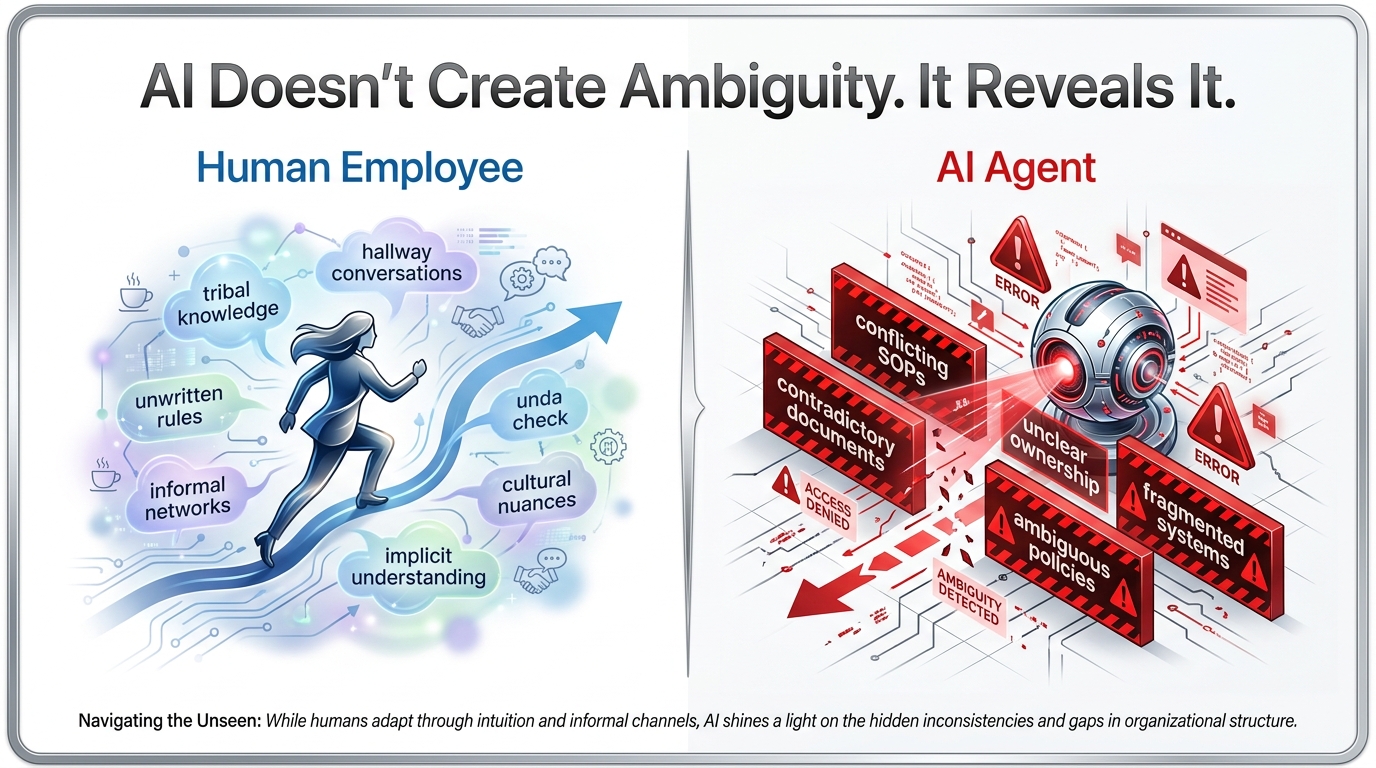
AI cannot compensate for ambiguity the way humans do. It cannot read the room. It cannot pick up the phone and call the expert. It cannot triangulate from social cues and organizational context.
When AI encounters ambiguity — a term with multiple operational definitions, a policy with unspecified exceptions, a decision with unstated authority requirements — it does one of two things: it guesses, or it refuses to answer.
Neither outcome is acceptable in regulated environments. Neither is acceptable anywhere decisions carry real consequences.
AI doesn’t create the ambiguity in your organization. It reveals ambiguity that was already there, waiting to become a problem at scale.
Nobody Owns Meaning
Ask any organization who owns their systems. IT will raise their hand. Ask who owns their data. The data team will answer. Ask who owns security, compliance, or cloud infrastructure. You’ll get clear owners for all of it.
Ask who owns meaning — shared definitions, decision logic, policies, evidence standards, operational context — and you’ll find a gap.
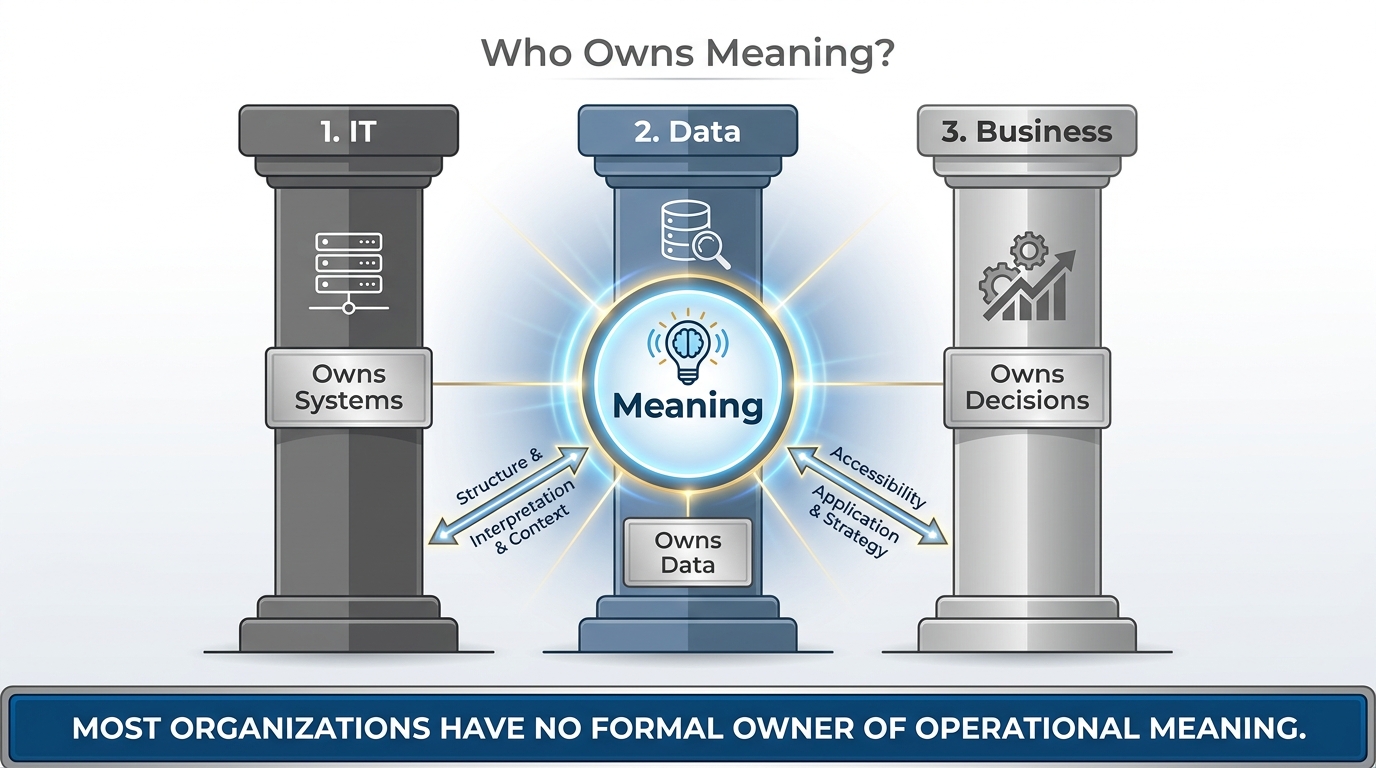
| Function | Owns |
|---|---|
| IT | Systems |
| Data Teams | Data |
| Security | Access |
| Business | Decisions |
| Nobody | Meaning |
A practitioner's framing worth quoting directly
Darlene Newman, AI Strategy & Transformation Advisor, put this gap into sharp focus recently: "Meaning was never declared infrastructure. IT owns systems. Data teams own data. Business teams own decisions. But the shared definitions, decision logic, and domain knowledge that sit between data and decisions? They belong to nobody. So context gets rebuilt inside every prompt, every workflow, every agent, every implementation. Not because teams are careless. Because meaning was never declared infrastructure."
That is an exact description of the problem — and it mirrors what we hear from every enterprise AI program that moves past the proof-of-concept stage.
This isn’t a failure of leadership or organizational design. It’s a historical artifact. Before AI, meaning didn’t need to be explicitly owned because humans carried it. The organizational knowledge embedded in people’s heads was sufficient to run operations, make decisions, and preserve institutional continuity.
AI changed that equation. AI requires explicit meaning. It cannot infer what was never stated. It cannot apply judgment that was never codified. It cannot honor distinctions that were never documented.
Meaning was never declared infrastructure — because, until AI, it never had to be.
Why Regulated Industries Feel This First
Every enterprise eventually confronts the meaning problem. But regulated industries feel it first and most acutely — because in these industries, meaning isn’t just operationally important. It’s legally required.
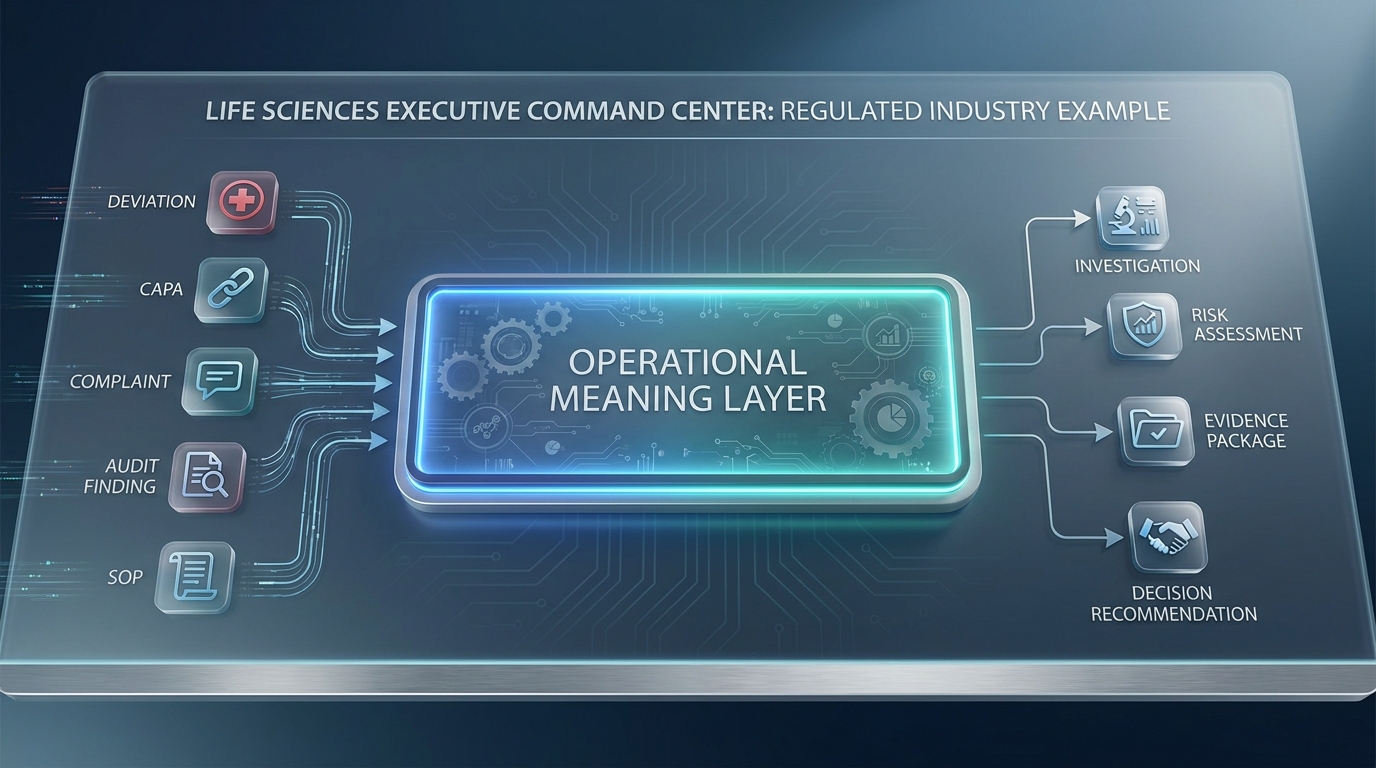
In life sciences and MedTech, FDA 21 CFR regulations, ISO 13485, and GxP standards don’t just require that you have the right information. They require that you interpret it correctly, document your reasoning, apply appropriate evidence standards, and demonstrate that the right people made the right decisions for the right reasons.
A CAPA isn’t just a record of what happened. It is a structured argument about root cause, corrective action, effectiveness, and closure — an argument that must be consistent with your quality system, defensible to an auditor, and grounded in an evidence standard that your organization has explicitly defined.
A complaint investigation isn’t just a lookup. It requires applying definitions (“what constitutes a complaint in our system?”), relationships (“is this related to a known device issue?”), authority models (“who is qualified to determine dispositioning?”), and policies (“what threshold triggers escalation?”).
None of that is retrieval. All of it is meaning.
When AI is deployed in these environments without operational meaning infrastructure, it either produces responses that are technically plausible but operationally wrong — or it produces nothing useful at all.
Introducing Operational Meaning Infrastructure
What regulated industries need — and what all enterprises will eventually need — is a dedicated infrastructure layer for operational meaning.
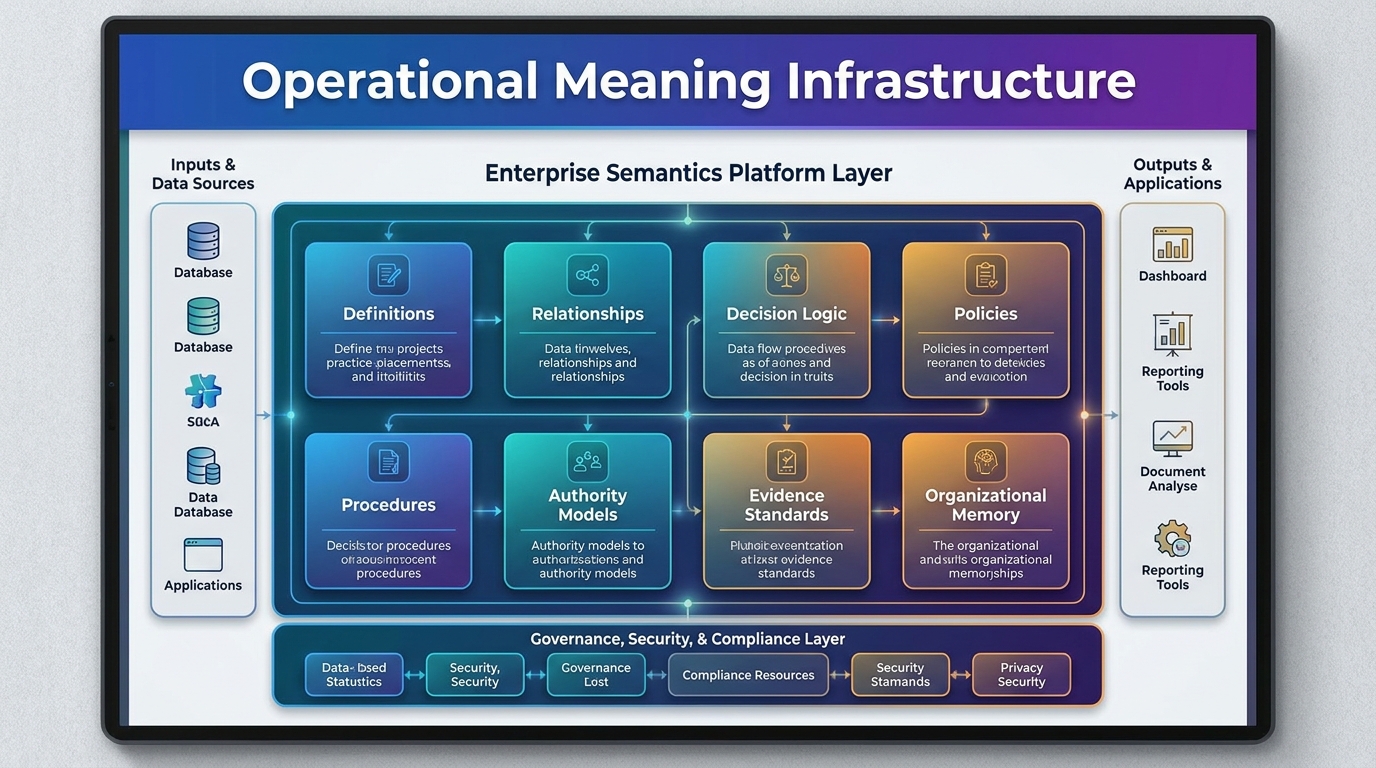
Operational Meaning Infrastructure is not a database. It is not a knowledge base. It is not a document repository. It is the set of governed structures that give AI systems — and the humans who work alongside them — a shared, authoritative understanding of how the organization thinks, decides, and operates.
It includes:
- Definitions — What do terms mean in this organization? Not dictionary definitions. Operational definitions that determine how systems classify, route, and act.
- Relationships — How do concepts, processes, systems, and records connect? What are the dependencies and constraints?
- Policies — What rules govern decisions? What exceptions exist, and under what conditions?
- Procedures — How is work done? What is the authoritative sequence? What determines completion?
- Authority Models — Who is qualified to make which decisions? What credentials, roles, or approvals are required?
- Evidence Standards — What constitutes sufficient support for a conclusion? What documentation is required?
- Organizational Memory — What has the organization learned? What decisions have been made and why?
- Decision Logic — How are determinations made? What factors are weighed? What thresholds trigger different outcomes?
This infrastructure doesn’t replace AI. It makes AI work — reliably, consistently, and in a way that can be governed, audited, and trusted.
The Future Enterprise AI Stack
The enterprise technology stack is undergoing a fundamental reorganization. The organizations that recognize it early will build durable AI capability. Those that don’t will continue cycling through pilots.
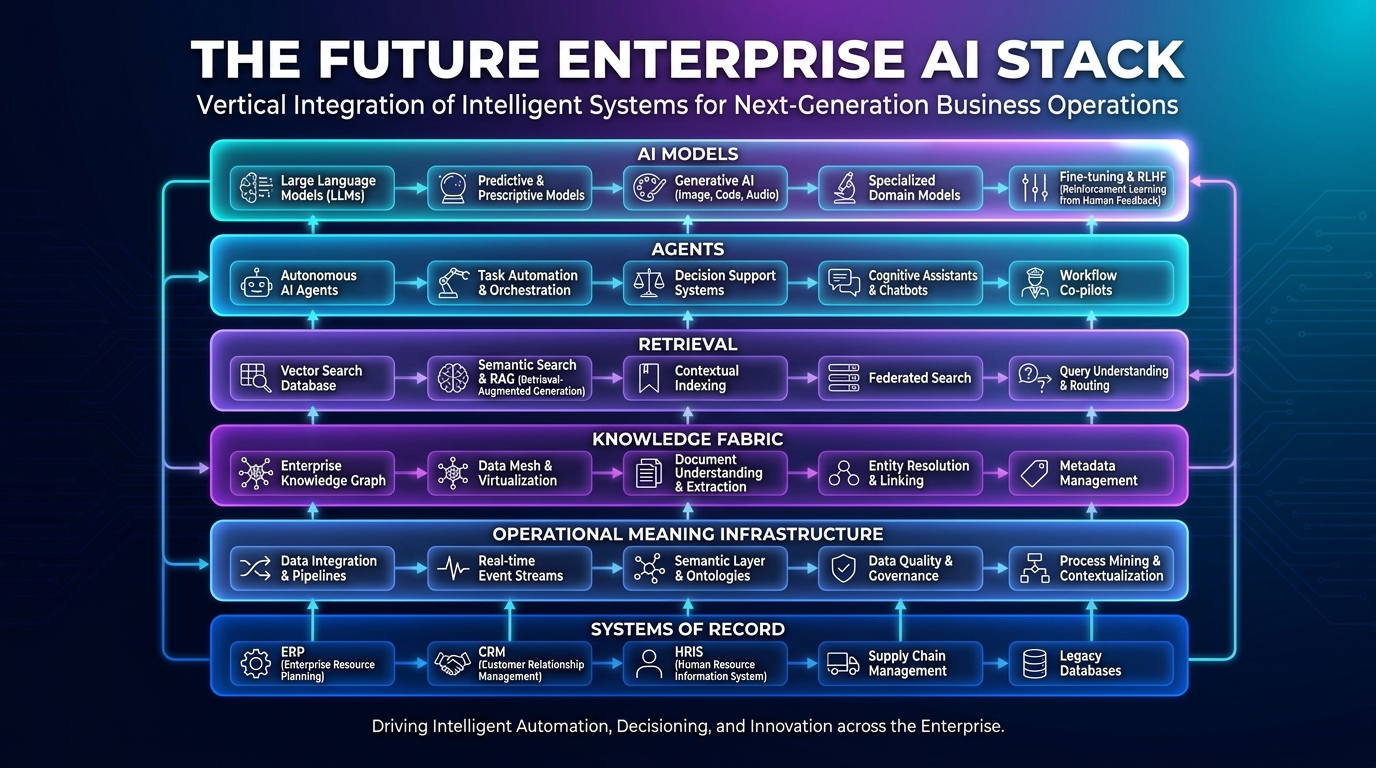
The emerging stack looks like this:
Systems of Record ↓ Operational Meaning Infrastructure ↓ Knowledge Fabric ↓ Retrieval ↓ Agents ↓ AI Models
Systems of record — ERP, QMS, CRM, PLM — continue to hold the transactions and documents. But before that data can be usefully retrieved, processed, and acted upon by AI, it must pass through an operational meaning layer that translates raw information into contextually understood, organizationally governed knowledge.
The knowledge fabric aggregates and structures that meaning. Retrieval surfaces relevant content from it. Agents and AI models then operate not on raw data, but on meaning-enriched knowledge.
Without the meaning layer, everything above it is unreliable. Retrieval returns information with no shared interpretation. Agents make decisions with no authority model. Models generate outputs with no organizational grounding.
Meaning is not a feature of AI. It is the foundation that makes AI trustworthy.
The Organizations That Win With AI
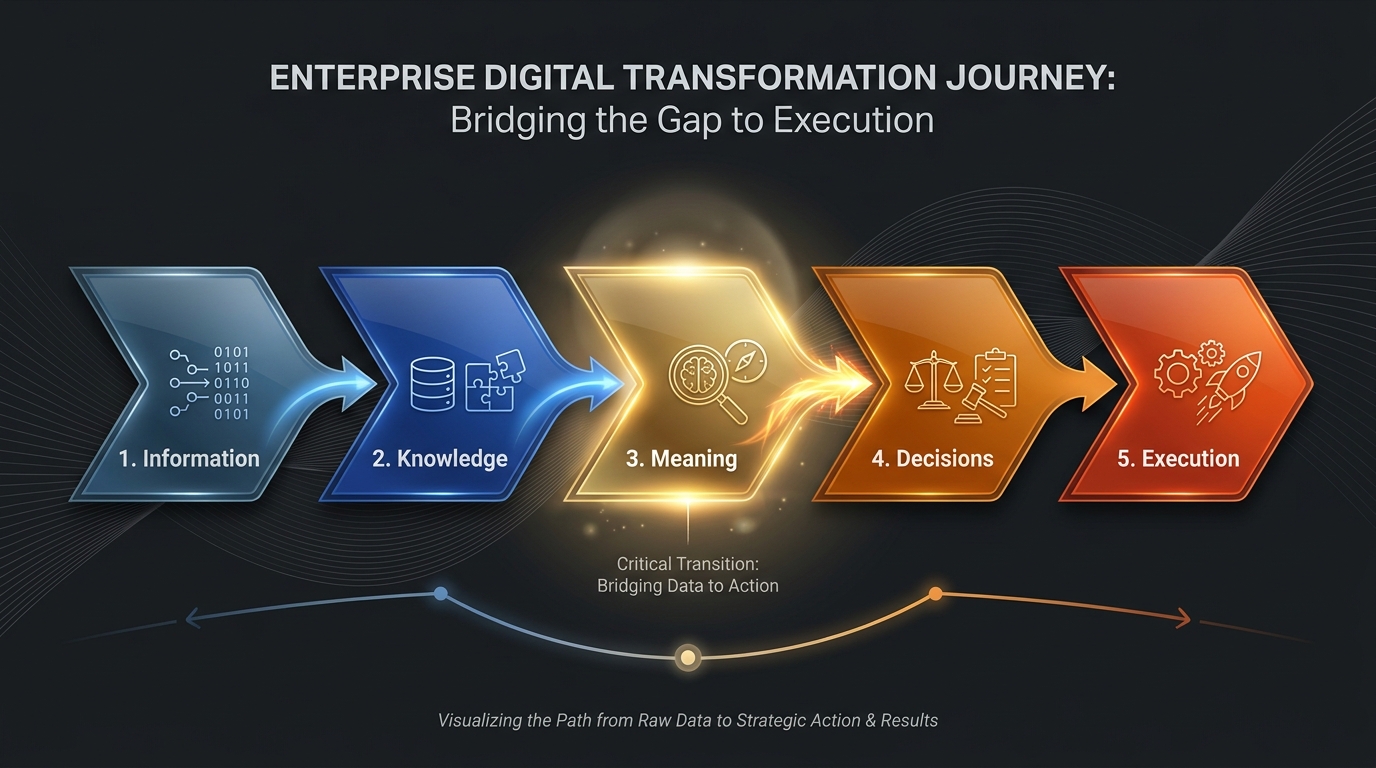
The next wave of enterprise AI advantage will not go to the organizations with the most data. It will not go to the organizations running the newest foundation models. It will not go to the organizations with the largest vector databases or the most sophisticated retrieval pipelines.
It will go to the organizations that have done the hard, unsexy, foundational work of making their operational meaning explicit — and building the infrastructure to govern, maintain, and operationalize it at scale.
This is what separates organizations that pilot AI from organizations that run on it.
Organizations that win will possess a shared understanding of operational meaning: what terms mean, how decisions are made, what evidence is required, who is authorized to act, and what the organization has learned from its own history.
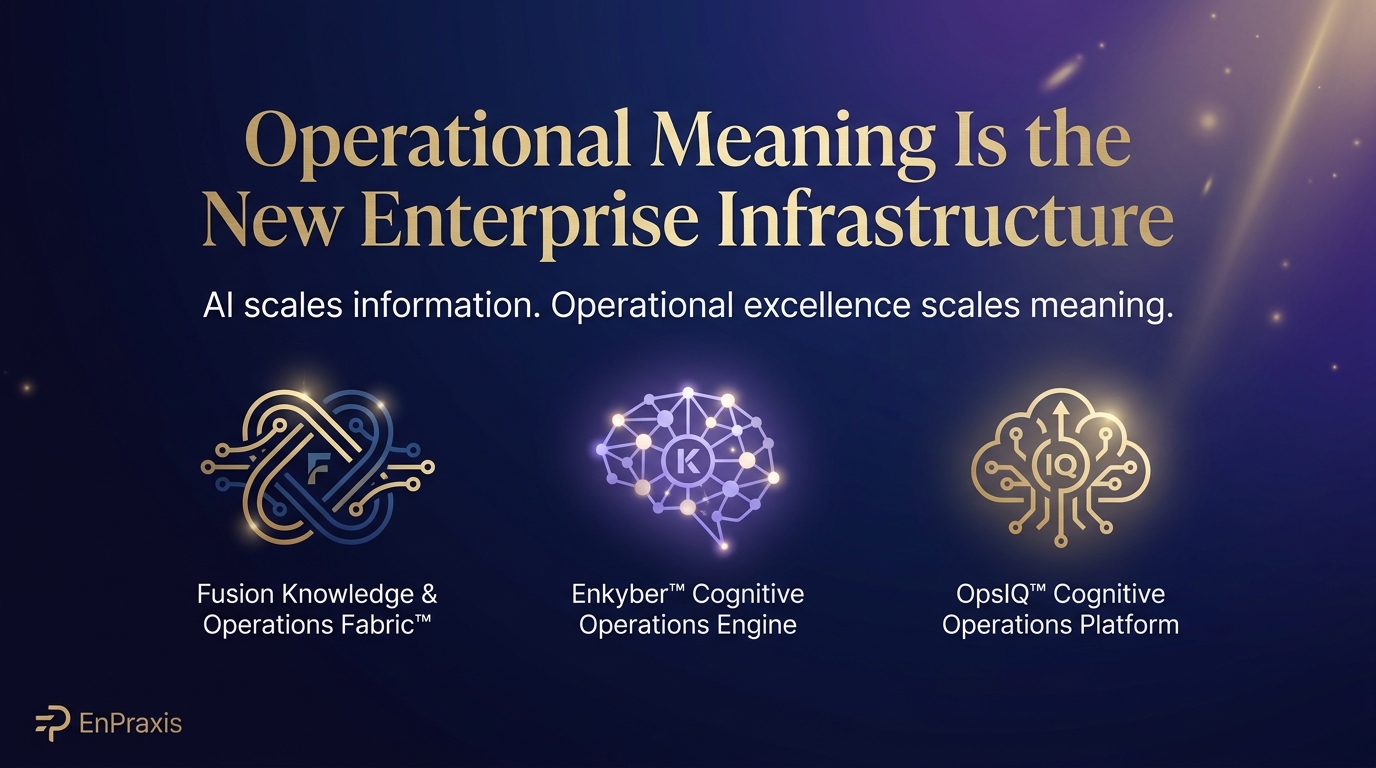
AI scales information.
Operational excellence scales meaning.
What this looks like in practice
EnPraxis has built the infrastructure layer for governed operational meaning. The Fusion Knowledge & Operations Fabric™ structures and governs organizational meaning across definitions, relationships, policies, procedures, and authority models. The Enkyber™ Cognitive Operations Engine activates that meaning inside AI workflows. The OpsIQ™ Cognitive Operations Platform makes it operational — giving teams governed, auditable AI that reflects how their organization actually thinks and decides.
See governed operational meaning in action
Explore how EnPraxis builds the meaning infrastructure that makes enterprise AI reliable, auditable, and ready for regulated environments.