
Regulatory inspections are among the most consequential operational events a regulated organization can experience.
For a few days or weeks, the organization is tested in real time. Investigators ask for evidence. Teams search for documents. Subject matter experts are pulled into urgent discussions. Quality leaders try to maintain control. Consultants help interpret risk. Executives want visibility. Everyone wants to avoid saying the wrong thing, producing the wrong document, missing a commitment, or exposing a weakness that could become a formal observation.
Most organizations prepare extensively for these moments. They conduct mock inspections. They build storyboards. They gather evidence. They coach subject matter experts. They create war rooms. They organize document repositories. They rehearse narratives. They bring in consultants.
And yet, when the inspection begins, the process often becomes chaotic.
The reason is simple: most organizations do not lack documents. They lack real-time inspection intelligence.
The problem is not inspection management. It is inspection understanding.
The Inspection Is Not a Single Event
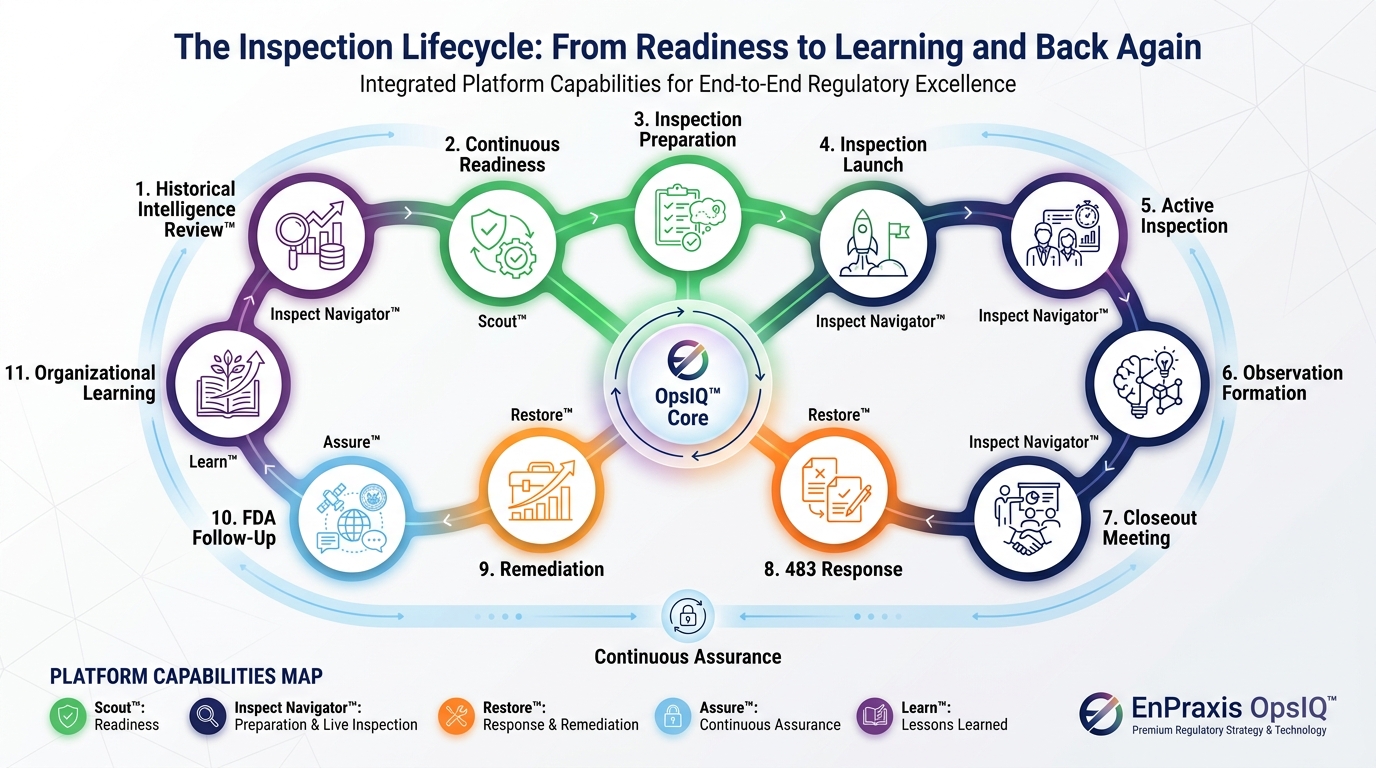
Many people think of an inspection as the visit itself. In reality, inspection is an operational lifecycle:
- Continuous readiness
- Inspection preparation
- Inspection launch
- Active inspection
- Observation formation
- Closeout meeting
- 483 response
- Remediation
- FDA follow-up
- Organizational learning
The visit is only the most visible part of the process. The risk begins much earlier and continues long after the investigators leave.
The Hidden Burden of Preparation
Before an inspection, teams often spend weeks or months preparing. They build storyboards to explain how core quality processes work. They review CAPAs, complaints, training records, validation packages, supplier files, deviations, audits, and management review materials. They simulate likely questions. They identify gaps. They prepare SMEs.
This work is important, but it is also expensive, manual, and difficult to maintain.
Storyboards often live in slides or documents. Evidence may sit across QMS, MES, LIMS, ERP, PLM, shared drives, and email. Tribal knowledge sits in people’s heads. Consultants may know where the weak spots are, but that knowledge often leaves when the engagement ends.
Preparation becomes a project rather than an always-on capability.
The War Room Reality
When the inspection begins, many organizations create two operating environments.
The first is the auditor or front room: the controlled environment where investigators interact with company representatives and receive responses.
The second is the war room or back room: the internal command center where teams interpret requests, search for documents, coordinate SMEs, review evidence, draft responses, manage escalations, and track commitments.
The war room is where the stress concentrates.
A request comes in. Someone assigns it. Someone searches for the document. Someone checks whether it is the right version. Someone asks an SME what it means. Someone worries about whether the document opens another line of questioning. Someone drafts a response. Someone else reviews it. Then the response is released. This happens again and again under time pressure.
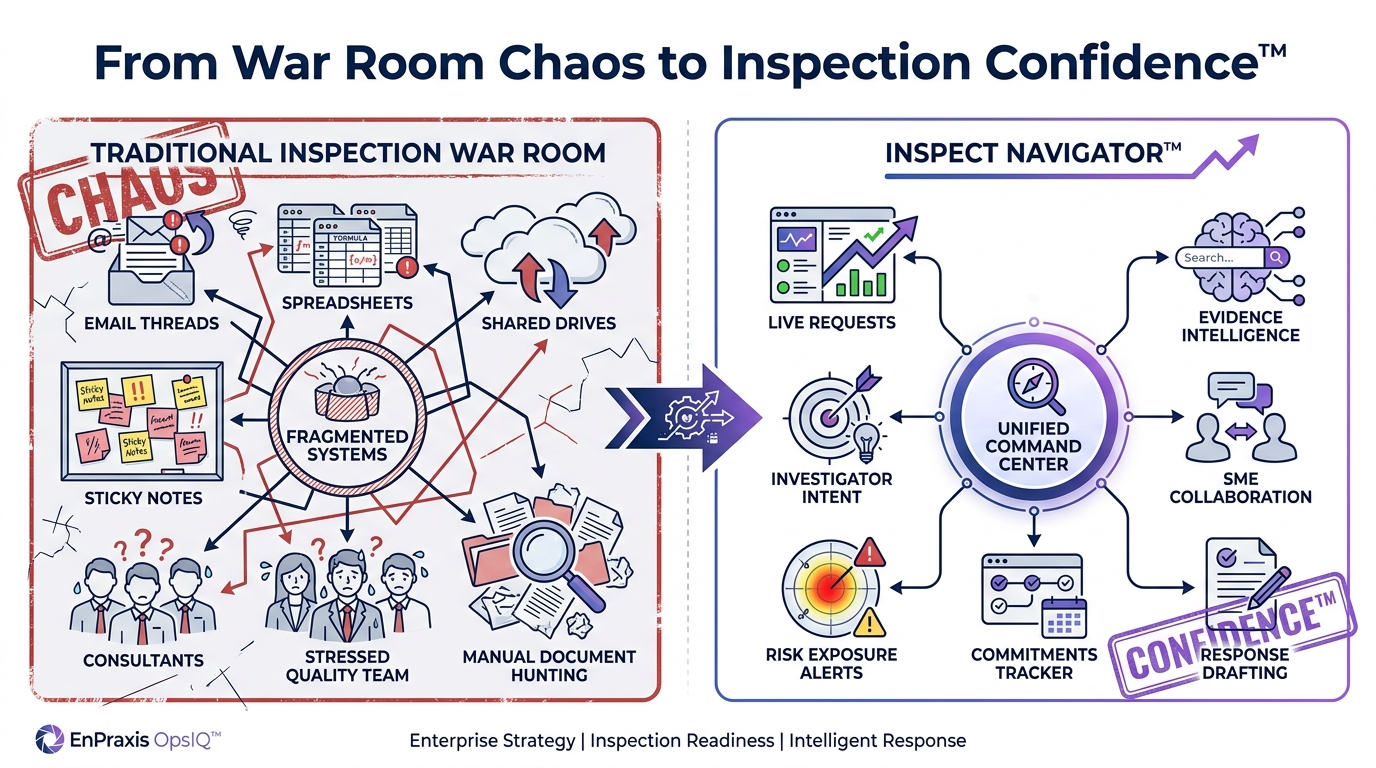
The problem is not that people are incapable. The problem is that the work is too fragmented.
The Difference Between Inspection Management and Inspection Intelligence
Most current approaches focus on inspection management. They help organizations track requests, manage documents, coordinate people, and organize the process. That is valuable.
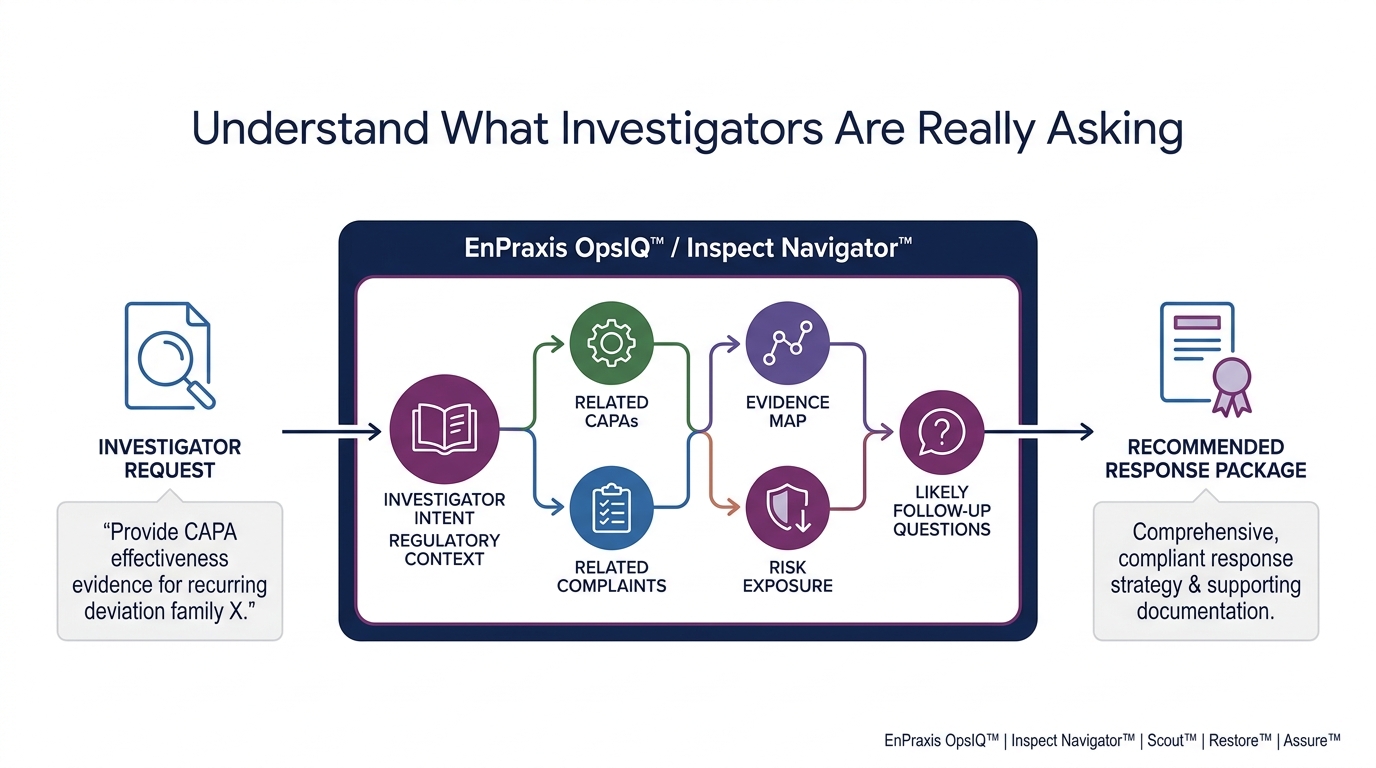
But inspection management does not answer the deeper questions:
- What is the investigator really asking?
- Why does this request matter?
- What risk does it imply?
- What related records may become relevant?
- What evidence is strongest?
- What follow-up questions are likely?
- Are our responses consistent?
- What commitments have we made?
- What are we learning from this inspection?
Those are intelligence questions. This is where Operational Inspection Intelligence™ becomes important.
Introducing Inspect Navigator™
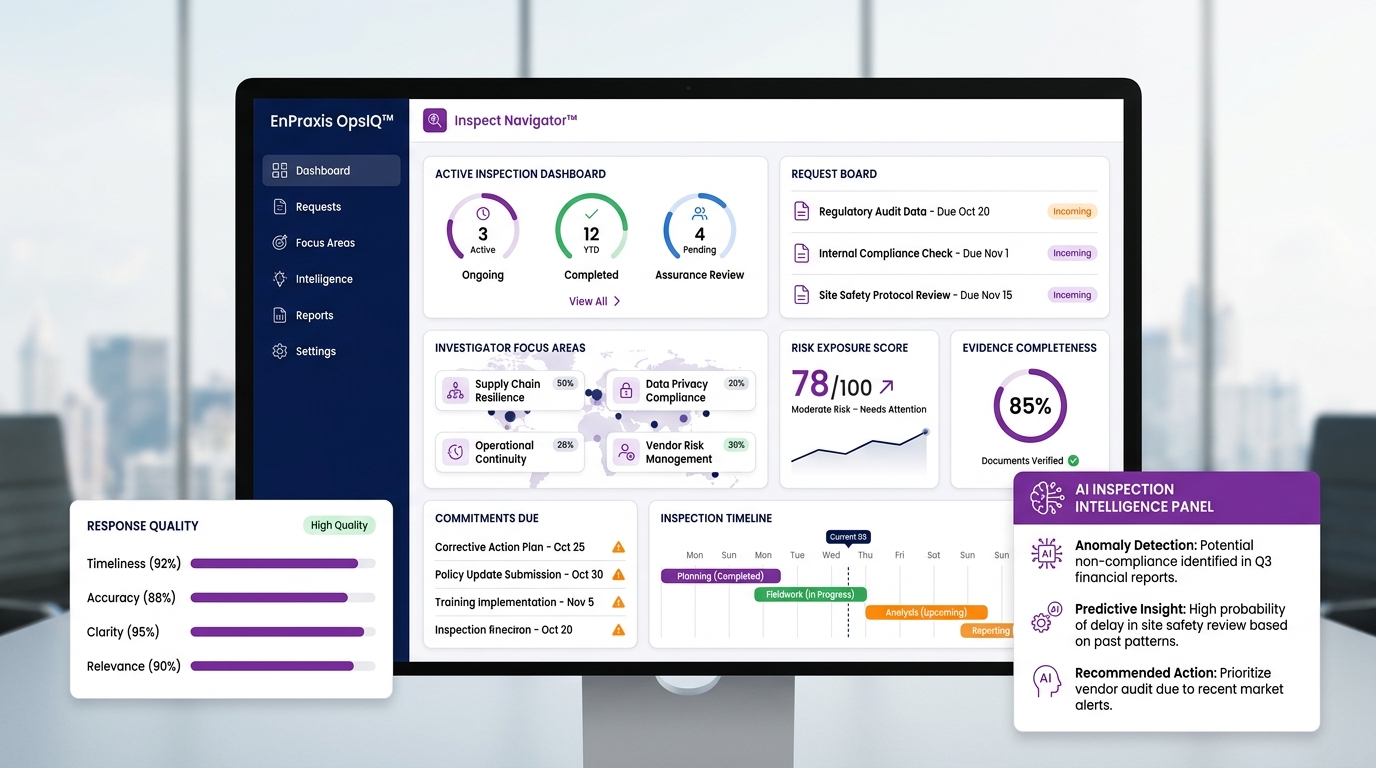
Inspect Navigator™ is EnPraxis’ agentic inspection intelligence application. It helps regulated organizations prepare for, manage, respond during, and learn from regulatory inspections by transforming requests, evidence, expert knowledge, and operational risk into real-time inspection intelligence.
Inspect Navigator™ does not replace quality experts. It helps them work with greater speed, clarity, and confidence. It supports:
- Inspection readiness planning
- Storyboard development
- Mock inspection simulation
- War Room coordination
- Auditor Room evidence delivery
- Request and evidence intelligence
- Investigator intent analysis
- Risk and exposure detection
- SME collaboration
- Commitment tracking
- Response drafting
- Closeout preparation
- Restore™ handoff for 483 response
- Lessons learned capture
The goal is not simply to make inspection work faster. The goal is to make inspection work more confident, more consistent, more traceable, and more defensible.
Why Historical Intelligence Comes First
There is a trust problem with any new technology in regulated environments. No quality leader wants to put an unproven AI tool in the middle of their most critical regulatory interaction.
That is why EnPraxis recommends starting with a Historical Intelligence Review™.
Instead of asking an organization to change how it handles an active inspection, we start by analyzing historical inspection data:
- Past 483s
- Warning Letters
- FDA correspondence
- Internal audit findings
- CAPAs
- Response packages
- Remediation plans
- Commitments
- Related evidence
We then show what happened, what worked, what did not, what was missed, and how the organization could have responded more effectively using the knowledge it already had at the time.
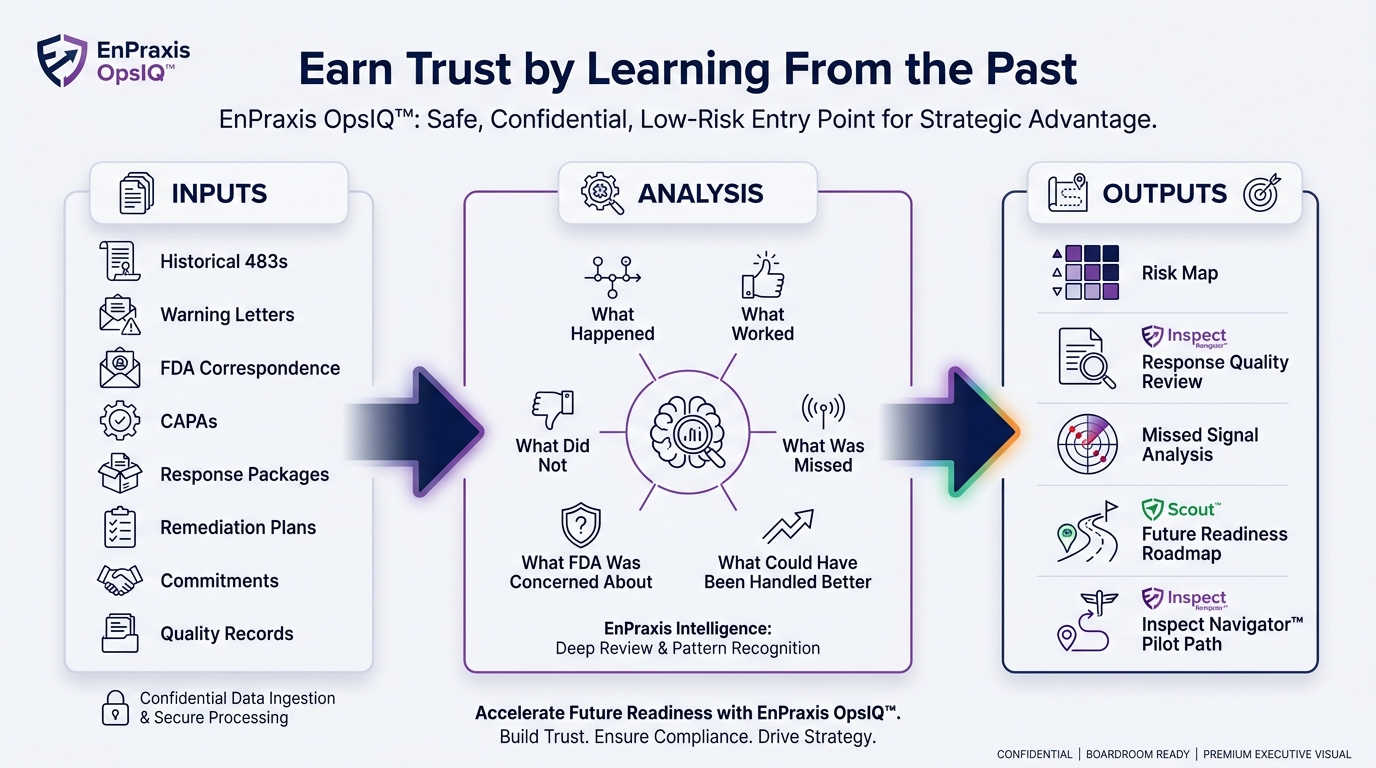
This creates a low-risk entry point. The organization gets value immediately. EnPraxis earns trust. The customer sees their own operational reality through a new intelligence lens.
Why the Market Is Larger Than Pharma
Operational Inspection Intelligence is not only a pharma problem. FDA and other regulators inspect many types of organizations, including human drug, medical device, and biologics manufacturers; CDMOs and CROs; food manufacturers and processors; cosmetics, dietary supplement, and animal health companies; tobacco product companies; radiation-emitting product manufacturers; and importers and foreign manufacturers.
The content differs by industry. The inspection pattern is remarkably similar:
Requests → Evidence → Traceability → Investigations → Controls → CAPA → Management Oversight → Effectiveness
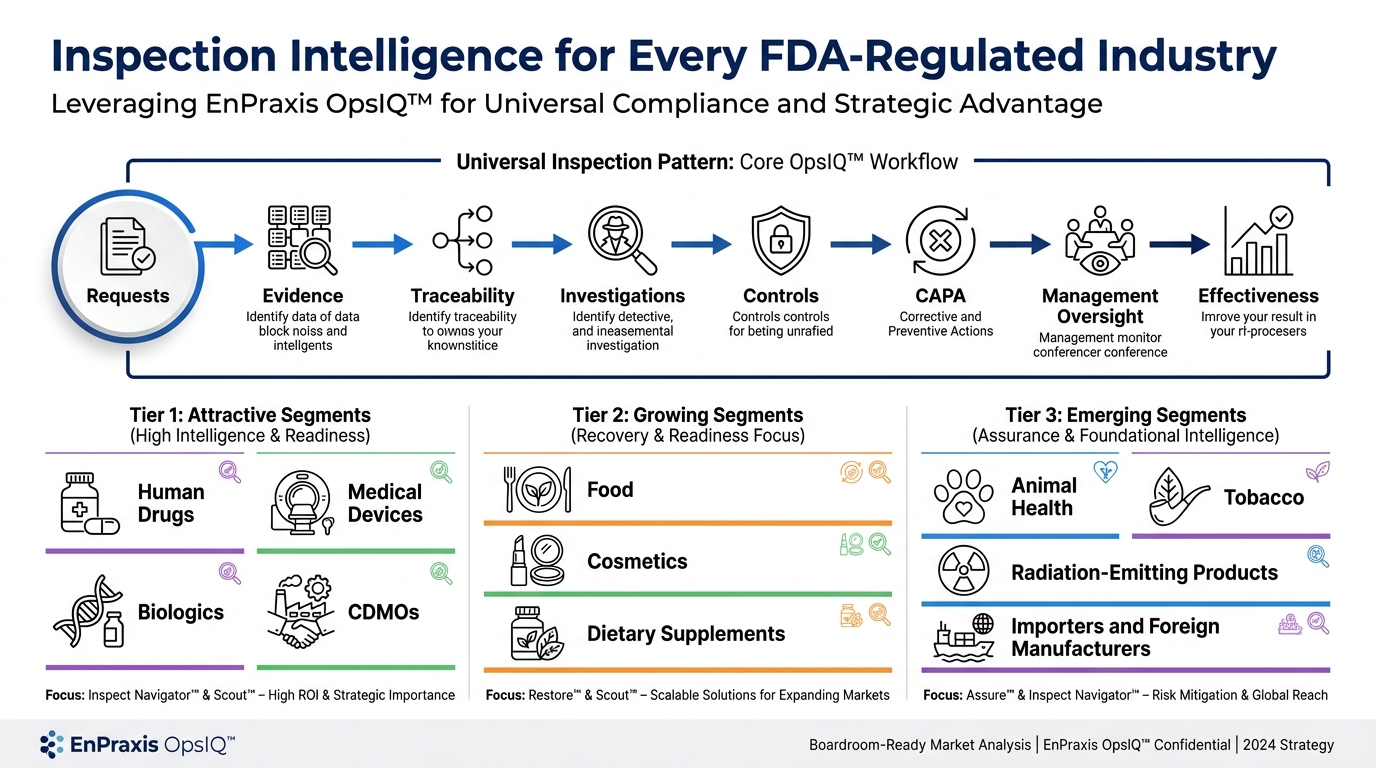
The universal pattern creates a much larger opportunity than traditional compliance recovery.
Why This Matters Now
Regulated organizations face increasing complexity, higher scrutiny, more fragmented systems, and growing pressure to do more with less. At the same time, inspections remain one of the most stressful and consequential moments in the life of a regulated company.
The current model relies heavily on manual preparation, document hunting, consultants, spreadsheets, meetings, and war rooms. That model is expensive and fragile.
Operational Inspection Intelligence offers a better path. It gives teams a way to prepare more intelligently, respond more confidently, capture what they learn, and improve continuously.
The Future of Inspection Readiness
The future is not a larger war room. The future is a smarter inspection operating environment.
One where every request is understood in context. One where evidence is traceable. One where SMEs are prepared. One where commitments are not lost. One where leaders have visibility. One where lessons become institutional knowledge. One where each inspection makes the organization stronger.
That is the purpose of Inspect Navigator™.
Regulatory inspections will always be high-stakes. They do not have to be chaotic.
Ready to see what your past inspections can teach you? Start with a Historical Intelligence Review™ and discover how Inspect Navigator™ can help your organization prepare, respond, recover, and improve with greater confidence. Explore Inspect Navigator →